Leucine, Phenylalanine, Lysine, Methionine, Isoleucine, Valine, Histidine, Threonine, Tryptophan, Alanine, Glycine, Arginine, Proline, Serine, Tyrosine, Dibasic Potassium Phosphate, Magnesium Chloride, Sodium Chloride, Calcium Chloride, Dextrose
Managing this medication for someone you care for? Eleplan keeps diagnoses, medications and appointments in one plan.
Start free with EleplanMedication reference
Leucine, Phenylalanine, Lysine, Methionine, Isoleucine, Valine, Histidine, Threonine, Tryptophan, Alanine, Glycine, Arginine, Proline, Serine, Tyrosine, Dibasic Potassium Phosphate, Magnesium Chloride, Sodium Chloride, Calcium Chloride, Dextrose
Amino Acid [EPC] — INTRAVENOUS
Leucine, Phenylalanine, Lysine, Methionine, Isoleucine, Valine, Histidine, Threonine, Tryptophan, Alanine, Glycine, Arginine, Proline, Serine, Tyrosine, Dibasic Potassium Phosphate, Magnesium Chloride, Sodium Chloride, Calcium Chloride, Dextrose — Amino Acid [EPC]. INDICATIONS AND USAGE CLINIMIX E is indicated as a source of calories, protein, and electrolytes for patients requiring parenteral nutrition when…
Brand names
CLINIMIX E
Active ingredients
ALANINEARGININECALCIUM CHLORIDEDEXTROSEGLYCINEHISTIDINEISOLEUCINELEUCINELYSINEMAGNESIUM CHLORIDEMETHIONINEPHENYLALANINEPOTASSIUM PHOSPHATE, DIBASICPROLINESERINESODIUM CHLORIDETHREONINETRYPTOPHANTYROSINEVALINESODIUM ACETATE
Indications
INDICATIONS AND USAGE CLINIMIX E is indicated as a source of calories, protein, and electrolytes for patients requiring parenteral nutrition when oral or enteral nutrition is not possible, insufficient, or contraindicated. CLINIMIX E may be used to treat negative nitrogen balance in patients. CLINIMIX E is indicated as a source of calories, protein, and electrolytes for patients requiring parenteral nutrition when oral or enteral nutrition is not possible, insufficient, or contraindicated. CLINIMIX E may be used to treat negative nitrogen balance in patients. ( 1 )
Dosage
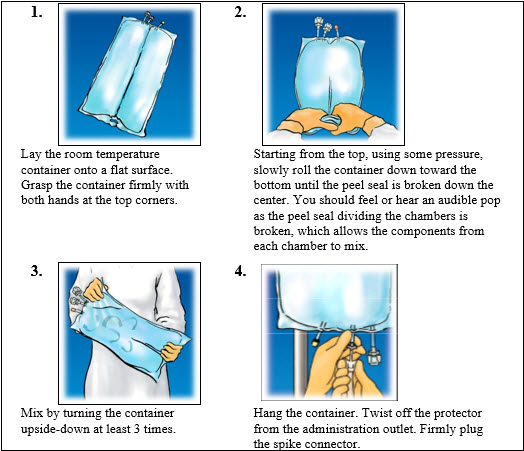
DOSAGE AND ADMINISTRATION See full prescribing information for information on preparation, administration, instructions for use, dosing considerations, including the recommended dosage in adults and pediatrics, and dosage modifications in patients with kidney disease. ( 2.1 , 2.2 , 2.3 , 2.4 , 2.5 , 2.6 , 2.7 , 2.8 ) 2.1 Preparation Prior to Administration • CLINIMIX E is available in a three port container configuration and a two port container configuration. • Three Port Container: the ports consist of one medication port, one additive port and one outlet port. Additives can be introduced to the container through the medication port and lipids through the additive port on the three port container. • Two Port Container: the ports consist of one medication port and one outlet port. Additives, including lipids, can be introduced to the container through the medication port on the two port container. • Tear protective overwrap at slit and remove solution container. Small amounts of moisture may be found on the solution container from water permeating from inside the container. The amount of permeated water is insufficient to affect the solution significantly. If larger amounts of water are found, the container should be checked for tears or leaks. • Inspect the container prior to activation. Some opacity of the plastic due to moisture absorption during the sterilization process may be observed. This is normal and does not affect the solution quality or safety. The opacity will diminish gradually. Evaluate the following: • If the outlet or additive port protectors are damaged, detached, or not present, discard container as solution path sterility may be impaired. • Check to ensure seal between chambers is intact, solutions are contained in separate chambers, and the content of the individual chambers is clear, colorless or slightly yellow. Discard if the seal is broken or if the solution is bright yellow or yellowish brown. • Check for minute leaks by separately squeezing each chamber. If external leaks or leakage between the chambers are found, discard solution as sterility or stability may be impaired. • Lipids and/or additives can be introduced to the container after opening seal between chambers. Because additives may be incompatible, evaluate all additions to the plastic container for compatibility. Activate chambers of container prior to introduction of additives. Mix thoroughly when additives have been introduced. Supplemental medication may be added with a 19 to 22 gauge needle through the medication port. • Calcium and phosphate ratios must be considered. Excess addition of calcium and phosphate, especially in the form of mineral salts, may result in the formation of calcium phosphate precipitates [see Warnings and Precautions (5.1) ]. • Inspect the container to ensure precipitates have not formed during the mixing or addition of additives. A slight yellow color does not alter the quality and efficacy of this product. If lipid has been added, ensure the emulsion has not separated. Separation of the emulsion can be visibly identified by a yellowish streaking or the accumulation of yellowish droplets in the mixed emulsion. Discard the admixture if any of the above are observed. 2.2 Important Administration Instructions • Set the vent to the closed position on a vented intravenous administration set to prevent air embolism. • Use a dedicated line without any connections to avoid air embolism. • CLINIMIX E is for intravenous infusion only into a central or peripheral vein. The choice of a central or peripheral venous route should depend on the osmolarity of the final infusate. Solutions with osmolarity of 900 mOsm/L or greater must be infused through a central catheter [see Warnings and Precautions (5.7) ]. • For central vein infusion only: CLINIMIX E 4.25/10, 5/15, 5/20, 8/10, 8/14 • For central or peripheral vein infusion: CLINIMIX E 2.75/5 and 4.25/5 • The solution should be inspected for precipitates before admixing, after admixing, and again before administration. • Use a 0.22 micron filter for administration of CLINIMIX E. If a lipid is also administered, use a 1.2 micron filter. • If lipid emulsion is added, do not use administration sets and lines that contain di-2-ethylhexyl phthalate (DEHP). Administration sets that contain polyvinyl chloride (PVC) components have DEHP as a plasticizer. • Ceftriaxone must not be administered simultaneously with calcium-containing intravenous solutions such as CLINIMIX E via a Y-site. However, in patients other than neonates, ceftriaxone and CLINIMIX E may be administered sequentially if the infusion lines are thoroughly flushed between infusions with a compatible fluid [see Contraindications (4) , Warnings and Precautions (5.2) ] . 2.3 Instructions for Use 1. Open by tearing protective overwrap at slit and remove solution container. The two port container includes an oxygen-absorbing sachet. Discard the oxygen-absorbing sachet after removal from the overwrap. 2. To proceed with activation, the container should be at room temperature. Lay the room temperature container onto a flat surface. Grasp the container firmly on each side of the top of the container ( Figure 1 ). 3. Starting from the top, using some pressure, slowly roll the container to open seal between chambers as shown in Figure 2 . Do not pull or rip the seal apart. The seal must be completely opened towards the port side of the container. The upper section of the seal towards the hanger side can remain unbroken. 4. Mix the contents thoroughly by inverting the container upside down to ensure a homogenous admixture ( Figure 3 ). 5. Once the container is mixed, check for leaks. 6. Make additions (if prescribed). Because additives may be incompatible, evaluate all additions to the container for compatibility and stability of the resulting preparation. Consult with pharmacist, if available. Questions about compatibility may be directed to Baxter. If it is deemed advisable to introduce additives, use aseptic technique. For information on adding lipid emulsions see Dosage and Administration (2.4) . a. Prepare medication port. b. Using syringe with 19 to 22 gauge needle, puncture resealable medication port and inject. c. Mix solution and medication thoroughly ( Figure 3 ). For high density medication (high specific gravity), such as potassium chloride, squeeze ports while ports are upright and mix thoroughly. 7. Inspect final solution for discoloration and particulate matter. Check for leaks. 8. Spike and hang container. a. Suspend container from eyelet support. b. Twist off protector from outlet port at bottom of container ( Figure 4 ). c. Attach administration set. Refer to complete directions accompanying set. For single dose only. Discard unused portion. Figures 1 – 4 (Three Port Container): Figures 1 – 4 (Two Port Container): Instructions on Storage Storage After Removal of Overwrap: Once removed from the protective overwrap, mixed (peel seal activated) or unmixed (peel seal intact), CLINIMIX E solutions may be stored under refrigeration for up to 9 days. Storage Once any Additive is Added: Use promptly after mixing. Any storage with additives should be under refrigeration and limited to a brief period of time, less than 24 hours. After removal from refrigeration, use promptly and complete the infusion within 24 hours. Any remaining mixture must be discarded. Protect the activated parenteral nutrition solution from light. Figure 1-4 Clinimix E Figures 1-4 - (Two Port Container) 2.4 Preparation and Addition of Lipid Emulsion Three Port Container 1. Prior to adding lipid emulsion, mix amino acid and dextrose injection as shown in Figures 1-3 . 2. Prepare lipid emulsion transfer set following instructions provided. 3. Attach transfer set to lipid emulsion container using aseptic technique. 4. Twist off protector on the additive port of the container. 5. Attach the transfer set to the exposed additive port. 6. Open clamp on transfer set. 7. After c
Warnings
WARNINGS AND PRECAUTIONS • Pulmonary Embolism due to Pulmonary Vascular Precipitates: if signs of pulmonary distress occur, stop the infusion and initiate a medical evaluation. ( 5.1 ) • Precipitation with Ceftriaxone: do not administer ceftriaxone simultaneously with CLINIMIX E via a Y-site. ( 4 , 5.2 , 8.4 ) • Hypersensitivity Reactions: monitor for signs and symptoms and discontinue infusion if reactions occur. ( 5.3 ) • Risk of Infections, Refeeding Complications, and Hyperglycemia or Hyperosmolar Hyperglycemic State: monitor for signs and symptoms; monitor laboratory parameters. ( 5.4 , 5.5 , 5.6 ) • Vein Damage and Thrombosis: solutions with osmolarity of ≥ 900 mOsm/L must be infused through a central catheter. ( 2.2 , 5.7 ) • Hepatobiliary Disorders: monitor liver function parameters and ammonia levels. ( 5.8 ) • Aluminum Toxicity: increased risk in patients with impaired kidney function, including preterm infants. ( 5.9 , 8.4 ) • Parenteral Nutrition Associated Liver Disease: increased risk in patients who receive parenteral nutrition for extended periods of time, especially preterm infants; monitor liver function tests, if abnormalities occur consider discontinuation or dosage reduction. ( 5.10 , 8.4 ) • Electrolyte Imbalance and Fluid Overload: patients with cardiac insufficiency or kidney disease may require adjustment of fluid, protein and electrolyte content. ( 5.11 , 8.4 ) 5.1 Pulmonary Embolism due to Pulmonary Vascular Precipitates Pulmonary vascular precipitates causing pulmonary vascular emboli and pulmonary distress have been reported in patients receiving parenteral nutrition. In some cases, fatal outcomes due to pulmonary embolism have occurred. Patients, especially those with hypophosphatemia, may require the addition of phosphate. To prevent hypocalcemia, calcium supplementation should always accompany phosphate administration. Excessive addition of calcium and phosphate increases the risk of the formation of calcium phosphate precipitates. Precipitates have been reported even in the absence of phosphate salt in the solution. Precipitation following passage through an in-line filter and suspected in vivo precipitate formation has also been reported. If signs of pulmonary distress occur, stop the infusion and initiate a medical evaluation. In addition to inspection of the solution [see Dosage and Administration (2.1 , 2.2 , 2.3 , 2.4 )] , the infusion set and catheter should also periodically be checked for precipitates. 5.2 Precipitation with Ceftriaxone Precipitation of ceftriaxone-calcium can occur when ceftriaxone is mixed with calcium-containing parenteral nutrition solutions, such as CLINIMIX E, in the same intravenous administration line. Do not administer ceftriaxone simultaneously with CLINIMIX E via a Y-site. Deaths have occurred in neonates (less than 28 days of age) who received concomitant intravenous calcium-containing solutions with ceftriaxone resulting from calcium-ceftriaxone precipitates in the lungs and kidneys, even when separate infusion lines were used. CLINIMIX E is contraindicated in neonates receiving ceftriaxone [see Contraindications (4) , Use in Specific Populations (8.4) ]. In patients older than 28 days (including adults), ceftriaxone and CLINIMIX E may be administered sequentially if the infusion lines are thoroughly flushed between infusions with a compatible fluid . 5.3 Hypersensitivity Reactions Hypersensitivity/infusion reactions including anaphylaxis have been reported with CLINIMIX E. Stop infusion immediately and treat patient accordingly if any signs or symptoms of a hypersensitivity reaction develop. Signs or symptoms may include: hypotension, hypertension, peripheral cyanosis, tachycardia, dyspnea, vomiting, nausea, urticaria, rash, pruritus, erythema, hyperhidrosis, pyrexia, and chills. 5.4 Risk of Infections Patients who require parenteral nutrition are at high risk of infections because the nutritional components of these solutions can support microbial growth. Infection and sepsis may also occur as a result of the use of intravenous catheters to administer parenteral nutrition. The risk of infection is increased in patients with malnutrition-associated immunosuppression, hyperglycemia exacerbated by dextrose infusion, long-term use and poor maintenance of intravenous catheters, or immunosuppressive effects of other concomitant conditions, drugs, or other components of the parenteral formulation (e.g., lipid emulsion). To decrease the risk of infection, ensure aseptic technique in catheter placement and maintenance, as well as aseptic technique in the preparation and administration of the nutritional formula. Monitor for signs and symptoms (including fever and chills) of early infections, including laboratory test results (including leukocytosis and hyperglycemia) and frequent checks of the parenteral access device and insertion site for edema, redness and discharge. 5.5 Refeeding Syndrome Refeeding severely undernourished patients may result in refeeding syndrome, characterized by the intracellular shift of potassium, phosphorus, and magnesium as the patient becomes anabolic. Thiamine deficiency and fluid retention may also develop. To prevent these complications, monitor severely undernourished patients and slowly increase nutrient intakes. 5.6 Hyperglycemia or Hyperosmolar Hyperglycemic State When using CLINIMIX E in patients with diabetes mellitus, impaired glucose tolerance may worsen hyperglycemia. Administration of dextrose at a rate exceeding the patient’s utilization rate may lead to hyperglycemia, coma, and death. Patients with dehydration, resulting in a transient reduction in glomerular filtration rate and pre-renal azotemia, may be at greater risk of developing hyperosmolar hyperglycemic state. Monitor blood glucose levels and treat hyperglycemia to maintain optimum levels while administering CLINIMIX E. Insulin may be administered or adjusted to maintain optimal blood glucose levels during CLINIMIX E administration. 5.7 Vein Damage and Thrombosis Solutions with osmolarity of 900 mOsm/L or greater must be infused through a central catheter. CLINIMIX E solutions containing more than 5% dextrose have an osmolarity greater than or equal to 900 mOsm/L. CLINIMIX E 4.25/10, 5/15, 5/20, 8/10 and 8/14 are indicated for administration into a central vein only, such as the superior vena cava [see Dosage and Administration (2.2) ] . The infusion of hypertonic nutrient injections into a peripheral vein may result in vein irritation, vein damage, and/or thrombosis. CLINIMIX E 2.75/5 and 4.25/5 are indicated for peripheral administration, or may be infused into a central vein [see Dosage and Administration (2.2) ] . The primary complication of peripheral access is venous thrombophlebitis, which manifests as pain, erythema, tenderness or a palpable cord. Remove the catheter as soon as possible, if thrombophlebitis develops. 5.8 Hepatobiliary Disorders Hepatobiliary disorders are known to develop in some patients without preexisting liver disease who receive parenteral nutrition, including cholecystitis, cholelithiasis, cholestasis, hepatic steatosis, fibrosis and cirrhosis, possibly leading to hepatic failure. The etiology of these disorders is thought to be multifactorial and may differ between patients. Increase in blood ammonia levels and hyperammonemia may occur in patients receiving amino acid solutions. In some patients this may indicate hepatic insufficiency or the presence of an inborn error of amino acid metabolism [see Contraindications (4) ] . Monitor liver function parameters and ammonia levels. Patients developing signs of hepatobiliary disorders should be assessed early by a clinician knowledgeable in liver diseases in order to identify possible causative and contributory factors, and possible therapeutic and prophylactic interventions. 5.9 Aluminum Toxicity CLINIMIX E contains no more than 25 mcg/L of aluminum. The aluminum contained in CLINIMIX E may reach toxic levels
Contraindications
CONTRAINDICATIONS The use of CLINIMIX E is contraindicated in: 1. Neonates (28 days of age or younger) receiving concomitant treatment with ceftriaxone, even if separate infusion lines are used, due to the risk of fatal ceftriaxone calcium salt precipitation in the neonate’s bloodstream [see Warnings and Precautions (5.2) , Use in Specific Populations (8.4) ] . 2. Patients with known hypersensitivity to one or more amino acids or dextrose [see Warnings and Precautions (5.3) ] . 3. Patients with inborn errors of amino acid metabolism due to risk of severe metabolic and neurologic complications. 4. Patients with pulmonary edema or acidosis due to low cardiac output. • Concomitant treatment with ceftriaxone in neonates (28 days of age or younger). ( 4 ) • Known hypersensitivity to one or more amino acids or dextrose. ( 4 ) • Inborn errors of amino acid metabolism. ( 4 ) • Patients with pulmonary edema or acidosis due to low cardiac output. ( 4 )
Drug interactions
DRUG INTERACTIONS 7.1 Drugs that Can Cause Hyperkalemia Because of its potassium content, CLINIMIX E should be administered with caution in patients treated with agents or products that can cause hyperkalemia or increase the risk of hyperkalemia, such as potassium sparing diuretics (amiloride, spironolactone, triamterene), with ACE inhibitors, angiotensin II receptor antagonists, or the immunosuppressants tacrolimus and cyclosporine.
Adverse reactions
ADVERSE REACTIONS The following serious adverse reactions are discussed in greater detail in other sections of the prescribing information. • Pulmonary embolism due to pulmonary vascular precipitates [see Warnings and Precautions (5.1) ] • Death in neonates due to calcium-ceftriaxone precipitates [see Warnings and Precautions (5.2) ] • Hypersensitivity reactions [see Warnings and Precautions (5.3) ] • Risk of Infections [see Warnings and Precautions (5.4) ] • Refeeding syndrome [see Warnings and Precautions (5.5) ] • Hyperglycemia or hyperosmolar hyperglycemic state [see Warnings and Precautions (5.6) ] • Vein damage and thrombosis [see Warnings and Precautions (5.7) ] • Hepatobiliary disorders [see Warnings and Precautions (5.8) ] • Parenteral Nutrition Associated Liver Disease (PNALD) [see Warnings and Precautions (5.10) ] • Electrolyte imbalance and fluid overload [see Warnings and Precautions (5.11) ] The following adverse reactions from voluntary reports or clinical studies have been reported with CLINIMIX E. Because many of these reactions were reported voluntarily from a population of uncertain size, it is not always possible to reliably estimate their frequency or establish a causal relationship to drug exposure. • Diuresis • Extravasation • Glycosuria • Hyperglycemia • Hyperosmolar coma Adverse reactions include diuresis, extravasation, glycosuria, hyperglycemia, and hyperosmolar coma. ( 6 ) To report SUSPECTED ADVERSE REACTIONS, contact Baxter Healthcare Corporation at 1-866-888-2472 or FDA at 1-800-FDA-1088 or www.fda.gov/medwatch
Mechanism of action
CLINICAL PHARMACOLOGY 12.1 Mechanism of Action CLINIMIX E is used as a supplement of nutrition in patients, providing macronutrients (amino acids and dextrose) and micronutrients (electrolytes) parenterally. The amino acids provide the structural units that make up proteins and are used to synthesize proteins and other biomolecules or are oxidized to urea and carbon dioxide as a source of energy. The administered dextrose is oxidized to carbon dioxide and water, yielding energy. 12.3 Pharmacokinetics The disposition of infused amino acids, dextrose, and electrolytes are essentially the same as those absorbed from ordinary food.
NDC examples
0338-02020338-11420338-1144
Indicated ICD-10 codes
Source: openFDA + RxNorm · 2026
Look up another medication