Indocyanine Green and Water
Managing this medication for someone you care for? Eleplan keeps diagnoses, medications and appointments in one plan.
Start free with EleplanMedication reference
Indocyanine Green and Water
Indocyanine Green and Water. INDICATIONS AND USAGE Indocyanine Green for injection is indicated: Indocyanine Green for injection is an optical imaging agent indicated for: •…
Brand names
Indocyanine Green
Indications
INDICATIONS AND USAGE Indocyanine Green for injection is indicated: Indocyanine Green for injection is an optical imaging agent indicated for: • Fluorescence imaging of vessels (micro- and macro-vasculature), blood flow and tissue perfusion before, during and after vascular, gastrointestinal, organ transplant, plastic, micro- and reconstructive surgeries, including general minimally invasive surgical procedures, in adults and pediatric patients aged 1 month and older ( 1.1 ) • Fluorescence imaging of extrahepatic biliary ducts in adults and pediatric patients aged 12 years and older ( 1.2 ) • Fluorescence imaging of lymph nodes and lymphatic vessels during lymphatic mapping in adults with cervical and uterine cancer ( 1.3 ) • Ophthalmic angiography in adults and pediatric patients ( 1.4 ) 1.1 Visualization of Vessels, Blood Flow and Tissue Perfusion Indocyanine Green is indicated for fluorescence imaging of vessels (micro- and macro- vasculature), blood flow and tissue perfusion before, during and after vascular, gastrointestinal, organ transplant, plastic, micro- and reconstructive surgeries, including general minimally invasive surgical procedures in adults and pediatric patients aged 1 month and older. 1.2 Visualization of Extrahepatic Biliary Ducts Indocyanine Green is indicated for fluorescence imaging of extrahepatic biliary ducts in adults and pediatric patients aged 12 years and older . 1.3 Lymphatic Mapping of Cervical and Uterine Cancer Indocyanine Green is indicated for fluorescence imaging of lymph nodes and delineation of lymphatic vessels during lymphatic mapping in adults with cervical and uterine cancer for which this procedure is a component of intraoperative management. 1.4 Ophthalmic Angiography Indocyanine Green is indicated for use in ophthalmic angiography in adults and pediatric patients.
Dosage
DOSAGE AND ADMINISTRATION For visual assessment of blood vessels, blood flow and related tissue perfusion ( 2.1 ) Under sterile conditions, the Indocyanine Green for Injection USP powder should be dissolved with the 10 mL Sterile Water for Injection, USP provided and the solution used within 6 hours after it is prepared. The usual doses of Indocyanine Green for Injection USP is 0.1 mg/kg (0.04 mL/kg) – 0.3 mg/kg (0.12 mL/kg). Immediately follow each ICG intravenous injection with a tight bolus injection of approximately 10 - 12 mL of normal saline immediately before IR imaging. Multiple administrations can be performed, up to 2 mg/kg (0.8 mL/kg) per patient. For visual assessment of the major extrahepatic bile ducts ( 2.2 ) Under sterile conditions, the Indocyanine Green for Injection USP powder should be dissolved with the 10 mL Sterile Water for Injection, USP provided and the solution used within 6 hours after it is prepared. The usual doses of Indocyanine Green for Injection USP is 3.0 mg (1.2 mL). Immediately follow each ICG intravenous injection with a tight bolus injection of approximately 10 - 12 mL of normal saline at least 30 minutes prior to IR imaging. Multiple administrations can be performed, up to 2 mg/kg (0.8 mL/kg) per patient. For viewing intra-operative blood flow in the cerebral area ( 2.3 ) Under sterile conditions, the Indocyanine Green for Injection USP powder should be dissolved with the 10 mL Sterile Water for Injection, USP provided and the solution used within 6 hours after it is prepared. The usual doses of Indocyanine Green for Injection USP is 0.1 mg/kg (0.04 mL/kg) – 0.3 mg/kg (0.12 mL/kg). Immediately follow each ICG intravenous injection with a tight bolus injection of approximately 10 - 12 mL of normal saline immediately before IR imaging Multiple administrations can be performed, up to 2 mg/kg (0.8 mL/kg) per patient. 2.1 Visual assessment of blood vessels, blood flow and related tissue perfusion Under sterile conditions, the Indocyanine Green for Injection USP powder should be dissolved with the 10 mL Sterile Water for Injection, USP provided for this product, and the solution used within 6 hours after it is prepared. If a precipitate is present, discard the solution. The patient should be weighed and the dosage for one administration should be calculated on the basis of 0.1 mg/kg (0.04 mL/kg) - 0.3 mg/kg (0.12 mL/kg) of body weight. Multiple administrations can be performed, up to 2 mg/kg (0.8 mL/kg) per patient. ICG should be administrated immediately before IR imaging. Item Note Indocyanine Green for Injection, USP 25 mg vials of ICG powder Sterile Water for Injection (for dissolving ICG) 10 mL vial of sterile water Syringe (for injecting sterile water into the ICG vial) Use the syringe whose minimum volume is 10 mL Syringes (for each administration) Considering the administration volume, select the appropriate size Sterile normal saline (for each saline flush) Approximately 10 – 12 mL following each ICG administration Syringes (for each saline flush) Use the syringe whose minimum volume is 12 mL Prepare the syringes filled with the weight-scaled dose of ICG solution, and the syringes filled with 10 - 12 mL of normal saline for the tight bolus injection. Immediately before IR imaging, administer the prepared dose of ICG solution intravenously. Immediately follow each ICG injection with a tight bolus injection of approximately 10 - 12 mL of normal saline. 2.2 Visual assessment of the major extrahepatic bile duct Under sterile conditions, the Indocyanine Green for Injection USP powder should be dissolved with the 10 mL Sterile Water for Injection, USP provided for this product, and the solution used within 6 hours after it is prepared. If a precipitate is present, discard the solution. The dosage for one administration should be 3.0 mg (1.2 mL) per patient. Multiple administration can be performed, up to 2 mg/kg (0.8 mL/kg) per patient. ICG should be administrated at least 30 minutes prior to IR imaging. Item Note Indocyanine Green for Injection, USP 25 mg vials of ICG powder Sterile Water for Injection (for dissolving ICG) 10 mL vial of sterile water Syringe (for injecting sterile water into the ICG vial) Use the syringe whose minimum volume is 10 mL Syringes (for each administration) Considering the administration volume, select the appropriate size Sterile normal saline (for each saline flush) Approximately 10 – 12 mL following each ICG administration Syringes (for each saline flush) Use the syringe whose minimum volume is 12 mL Prepare the syringes filled with 3.0 mg (1.2 mL) of ICG solution, and the syringes filled with 10 - 12 mL of normal saline for the tight bolus. At least 30 minutes prior to IR imaging, administer the prepared dose of ICG solution intravenously. Immediately follow each ICG injection with a tight bolus injection of approximately 10 - 12 mL of normal saline. 2.3 Viewing intra-operative blood flow in the cerebral area Under sterile conditions, the Indocyanine Green for Injection USP powder should be dissolved with the 10 mL Sterile Water for Injection, USP provided for this product, and the solution used within 6 hours after it is prepared. If a precipitate is present, discard the solution. The patient should be weighed and the dosage for one administration should be calculated on the basis of 0.1 mg/kg (0.04 mL/kg) - 0.3 mg/kg (0.12 mL/kg) of body weight. Multiple administration can be performed, up to 2 mg/kg (0.8 mL/kg) per patient. ICG should be administrated immediately before IR imaging. Item Note Indocyanine Green for Injection, USP 25 mg vials of ICG powder Sterile Water for Injection (for dissolving ICG) 10 mL vial of sterile water Syringe (for injecting sterile water into the ICG vial) Use the syringe whose minimum volume is 10 mL Syringes (for each administration) Considering the administration volume, select the appropriate size Sterile normal saline (for each saline flush) Approximately 10 – 12 mL following each ICG administration Syringes (for each saline flush) Use the syringe whose minimum volume is 12 mL Prepare the syringes filled with the weight-scaled dose of ICG solution, and the syringes filled with 10 - 12 mL of normal saline for the tight bolus. Immediately before IR imaging, administer the prepared dose of ICG solution intravenously. Immediately follow each ICG injection with a tight bolus injection of approximately 10 - 12 mL of normal saline.
Warnings
WARNINGS AND PRECAUTIONS • Deaths due to anaphylaxis have been reported following Indocyanine Green for Injection USP administration during cardiac catheterization. ( 5.1 ) • Indocyanine Green for Injection USP is unstable in aqueous solution and must be used within 6 hours. ( 5.2 ) • Radioactive iodine uptake studies should not be performed for at least a week following the use of Indocyanine Green for Injection USP. ( 5.3 ) 5.1 Anaphylaxis Deaths from anaphylaxis have been reported following Indocyanine Green for Injection USP administration during cardiac catheterization. 5.2 Drug Instability Indocyanine Green for Injection USP is unstable in aqueous solution and must be used within 6 hours. However, the dye is stable in plasma and whole blood so that samples obtained in discontinuous sampling techniques may be read hours later. Sterile techniques should be used in handling the dye solution as well as in the performance of the dilution curves. If a precipitate is present, discard the solution. 5.3 Drug/Laboratory Test Interactions Radioactive iodine uptake studies should not be performed for at least a week following the use of Indocyanine Green for Injection USP.
Contraindications
CONTRAINDICATIONS Indocyanine Green for Injection USP contains sodium iodide and should be used with caution in patients who have a history of allergy to iodides because of the risk of anaphylaxis. Indocyanine Green for Injection USP contains sodium iodide and should be used with caution in patients who have a history of allergy to iodides because of the risk of anaphylaxis. ( 4 )
Drug interactions
DRUG INTERACTIONS Interference with Thyroid Radioactive Iodine Uptake Studies Because Indocyanine Green contains sodium iodide, the iodine-binding capacity of thyroid tissue may be reduced for at least one week following administration. Do not perform radioactive iodine uptake studies for at least one week following administration of Indocyanine Green. Interference with Thyroid Radioactive Iodine Uptake Studies: Do not perform radioactive iodine uptake studies for at least one week following the use of Indocyanine Green. ( 7 )
Adverse reactions
ADVERSE REACTIONS The following clinically significant adverse reactions are described elsewhere in the labeling: • Hypersensitivity Reactions [see Warnings and Precautions ( 5.1 )] . The following adverse reactions have been identified during post-approval use of Indocyanine Green. Because these reactions are reported voluntarily from a population of uncertain size, it is not always possible to reliably estimate their frequency or establish a causal relationship to drug exposure. Immune System Disorders : Anaphylaxis, urticaria The most common adverse reactions reported are anaphylaxis and urticaria. ( 6 ) To report SUSPECTED ADVERSE REACTIONS, contact Diagnostic Green LLC at 1-844-424-3784 or FDA at 1-800-FDA-1088 or www.fda.gov/medwatch.
Mechanism of action
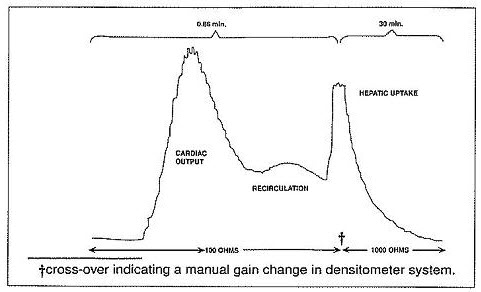
CLINICAL PHARMACOLOGY Indocyanine Green for Injection USP permits recording of the indicator-dilution curves for both diagnostic and research purposes independently of fluctuations in oxygen saturation. Following intravenous injection, Indocyanine Green for Injection USP is rapidly bound to plasma protein, of which albumin is the principle carrier (95%). Indocyanine Green for Injection USP undergoes no significant extrahepatic or enterohepatic circulation; simultaneous arterial and venous blood estimations have shown negligible renal, peripheral, lung or cerebro-spinal uptake of the dye. Indocyanine Green for Injection USP is taken up from the plasma almost exclusively by the hepatic parenchymal cells and is secreted entirely into the bile. After biliary obstruction, the dye appears in the hepatic lymph, independently of the bile, suggesting that the biliary mucosa is sufficiently intact to prevent diffusion of the dye, though allowing diffusion of bilirubin. These characteristics make Indocyanine Green for Injection USP a helpful index of hepatic function. The peak absorption and emission of Indocyanine Green for Injection USP lie in a region (800 to 850 nm) where transmission of energy by the pigment epithelium is more efficient than in the region of visible light energy. Indocyanine Green for Injection USP also has the property of being nearly 98% bound to blood protein, and therefore, excessive dye extravasation does not take place in the highly fenestrated choroidal vasculature. It is, therefore, useful in both absorption and fluorescence infrared angiography of the choroidal vasculature when using appropriate filters and film in a fundus camera. The plasma fractional disappearance rate at the recommended 0.5 mg/kg dose has been reported to be significantly greater in women than in men, although there was no significant difference in the calculated value for clearance.
NDC examples
73624-42470100-424
Treats these conditions
Source: openFDA + RxNorm · 2026
Look up another medication