Flibanserin — P-Glycoprotein Inhibitors [MoA]. INDICATIONS AND USAGE ADDYI is indicated for the treatment of women less than 65 years of age with acquired, generalized hypoactive sexual desire…
Boxed warning
WARNING: HYPOTENSION and SYNCOPE IN CERTAIN SETTINGS Interaction with Alcohol The use of ADDYI and alcohol together close in time increases the risk of severe hypotension and syncope [see Warnings and Precautions (5.1) ]. Counsel patients to wait at least two hours after consuming one or two standard alcoholic drinks before taking ADDYI at bedtime or to skip their ADDYI dose if they have consumed three or more standard alcoholic drinks that evening. Contraindicated with Strong or Moderate CYP3A4 Inhibitors The concomitant use of ADDYI and moderate or strong CYP3A4 inhibitors increases flibanserin concentrations, which can cause severe hypotension and syncope [see Warnings and Precautions (5.2) ] . Therefore, the use of moderate or strong CYP3A4 inhibitors is contraindicated in patients taking ADDYI [see Contraindications (4) ] . Contraindicated in Patients with Hepatic Impairment The use of ADDYI in patients with hepatic impairment increases flibanserin concentrations, which can cause severe hypotension and syncope [see Warnings and Precautions (5.5) ] . Therefore, ADDYI is contraindicated in patients with hepatic impairment [see Contraindications (4) ] . WARNING: HYPOTENSION and SYNCOPE IN CERTAIN SETTINGS See full prescribing information for complete boxed warning. • Use of ADDYI and alcohol together close in time increases the risk of severe hypotension and syncope. Counsel patients to wait at least two hours after consuming one or two standard alcoholic drinks before taking ADDYI at bedtime or to skip their ADDYI dose if they have consumed three or more standard alcoholic drinks that evening. ( 4 , 5.1 ) • Severe hypotension and syncope can occur when ADDYI is used with moderate or strong CYP3A4 inhibitors or in patients with hepatic impairment; therefore, ADDYI use in these settings is contraindicated. ( 4 , 5.2 , 5.5 )
INDICATIONS AND USAGE ADDYI is indicated for the treatment of women less than 65 years of age with acquired, generalized hypoactive sexual desire disorder (HSDD) as characterized by low sexual desire that causes marked distress or interpersonal difficulty and is not due to: • A co-existing medical or psychiatric condition, • Problems within the relationship, or • The effects of a medication or other drug substance. Acquired HSDD refers to HSDD that develops in a patient who previously had no problems with sexual desire. Generalized HSDD refers to HSDD that occurs regardless of the type of stimulation, situation or partner. Limitations of Use • ADDYI is not indicated in men. • ADDYI is not indicated to enhance sexual performance. ADDYI is indicated for the treatment of women less than 65 years of age with acquired, generalized hypoactive sexual desire disorder (HSDD) as characterized by low sexual desire that causes marked distress or interpersonal difficulty and is not due to ( 1 ): • A co-existing medical or psychiatric condition, • Problems within the relationship, or • The effects of a medication or other drug substance. Limitations of Use: • ADDYI is not indicated in men (1) • ADDYI is not indicated to enhance sexual performance. ( 1 )
Dosage
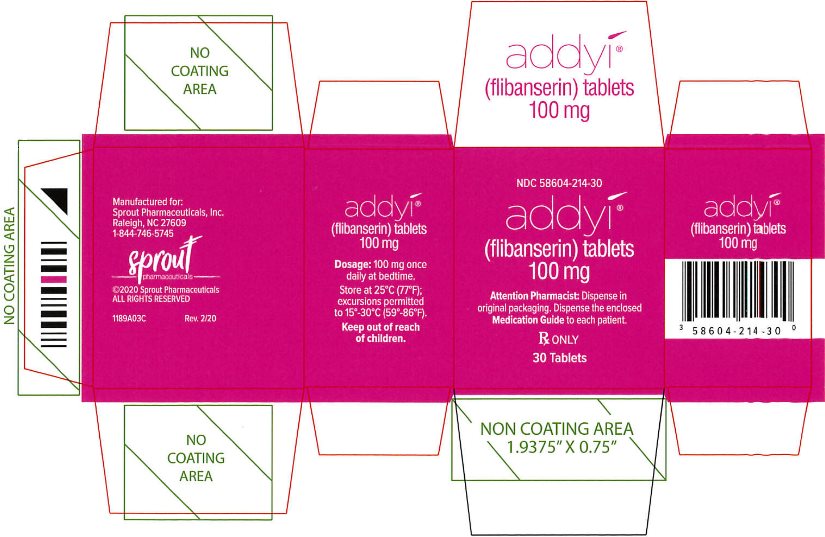
DOSAGE AND ADMINISTRATION • Recommended dosage is 100 mg taken once daily at bedtime (2.1) • ADDYI is dosed at bedtime because administration during waking hours increases risks of hypotension, syncope, accidental injury, and central nervous system (CNS) depression (2.1) • Discontinue ADDYI treatment after 8 weeks if no improvement (2.3) 2.1 Recommended Dosage The recommended dosage of ADDYI is 100 mg administered orally once per day at bedtime. ADDYI is dosed at bedtime because administration during waking hours increases the risks of hypotension, syncope, accidental injury, and central nervous system (CNS) depression (such as somnolence and sedation) . 2.2 Missed Dose If a dose of ADDYI is missed at bedtime, instruct the patient to take the next dose at bedtime on the next day. Instruct the patient to not double the next dose. 2.3 Discontinuation of ADDYI Discontinue ADDYI after 8 weeks if the patient does not report an improvement in her HSDD symptoms. 2.4 Initiation of ADDYI Following Moderate or Strong CYP3A4 Inhibitor Use If initiating ADDYI following moderate or strong CYP3A4 inhibitor use, start ADDYI 2 weeks after the last dose of the CYP3A4 inhibitor. If initiating a moderate or strong CYP3A4 inhibitor following ADDYI use, start the moderate or strong CYP3A4 inhibitor 2 days after the last dose of ADDYI [see Warnings and Precautions (5.2) ]. 2.1 Recommended Dosage The recommended dosage of ADDYI is 100 mg administered orally once per day at bedtime. ADDYI is dosed at bedtime because administration during waking hours increases the risks of hypotension, syncope, accidental injury, and central nervous system (CNS) depression (such as somnolence and sedation) . 2.2 Missed Dose If a dose of ADDYI is missed at bedtime, instruct the patient to take the next dose at bedtime on the next day. Instruct the patient to not double the next dose. 2.3 Discontinuation of ADDYI Discontinue ADDYI after 8 weeks if the patient does not report an improvement in her HSDD symptoms. 2.4 Initiation of ADDYI Following Moderate or Strong CYP3A4 Inhibitor Use If initiating ADDYI following moderate or strong CYP3A4 inhibitor use, start ADDYI 2 weeks after the last dose of the CYP3A4 inhibitor. If initiating a moderate or strong CYP3A4 inhibitor following ADDYI use, start the moderate or strong CYP3A4 inhibitor 2 days after the last dose of ADDYI [see Warnings and Precautions (5.2) ].
Warnings
WARNINGS AND PRECAUTIONS • Hypotension and Syncope due to an Interaction with Alcohol : After taking ADDYI at bedtime, advise patients to avoid alcohol until the following day. (5.1) • Central Nervous System (CNS) Depression (e.g., Somnolence, Sedation) : Can occur with ADDYI alone. Exacerbated by other CNS depressants, and in settings where flibanserin concentrations are increased. Patients should avoid activities requiring full alertness (e.g., driving or operating machinery) until at least six hours after each dose and until they know how ADDYI affects them. (5.3) • Hypotension and Syncope with ADDYI Alone : Patients with pre-syncope should immediately lie supine and promptly seek medical help if symptoms do not resolve. (5.4) • Hypersensitivity Reactions, including anaphylaxis, angioedema, pruritus, urticaria : Avoid in women with known hypersensitivity to ADDYI or any of its components ( 5.6 ) 5.1 Hypotension and Syncope due to an Interaction with Alcohol Taking ADDYI within two hours after consuming alcohol increases the risk of severe hypotension and syncope. To reduce this risk, counsel patients to wait at least two hours after drinking one or two standard alcoholic drinks before taking ADDYI at bedtime [see Boxed Warning and Adverse Reactions (6.1) ] . Patients who drink three or more standard alcoholic drinks should skip their ADDYI dose that evening. One standard alcoholic drink contains 14 grams of pure alcohol and is equivalent to one 12-ounce regular beer (5% alcohol), 5-ounces wine (12% alcohol), or 1.5 ounces of distilled spirits/shot (40% alcohol). After taking ADDYI at bedtime, advise patients to not use alcohol until the following day. 5.2 Hypotension and Syncope with CYP3A4 Inhibitors Moderate or Strong CYP3A4 Inhibitors The concomitant use of ADDYI with moderate or strong CYP3A4 inhibitors significantly increases flibanserin concentrations, which can lead to hypotension and syncope [see Adverse Reactions (6.1) ]. The concomitant use of ADDYI with a moderate or strong CYP3A4 inhibitor is contraindicated. If the patient requires a moderate or strong CYP3A4 inhibitor, discontinue ADDYI at least 2 days prior to starting the moderate or strong CYP3A4 inhibitor. In cases where the benefit of initiating a moderate or strong CYP3A4 inhibitor within 2 days of stopping ADDYI clearly outweighs the risk of flibanserin exposure related hypotension and syncope, monitor the patient for signs of hypotension and syncope. Discontinue the moderate or strong CYP3A4 inhibitor for 2 weeks before restarting ADDYI [see Drug Interactions (7) ]. Multiple Concomitant Weak CYP3A4 Inhibitors Concomitant use of multiple weak CYP3A4 inhibitors that may include herbal supplements (e.g., ginkgo, resveratrol) or non-prescription drugs (e.g., cimetidine) could also lead to clinically relevant increases in flibanserin concentrations that may increase the risk of hypotension and syncope [see Drug Interactions (7) ] . 5.3 Central Nervous System Depression ADDYI can cause CNS depression (e.g., somnolence, sedation). In five 24-week, randomized, placebo-controlled, double-blind trials of premenopausal women with HSDD, the incidence of somnolence, sedation or fatigue was 21% and 8% in patients treated with 100 mg ADDYI once daily at bedtime and placebo, respectively [see Adverse Reactions (6.1) and Clinical Studies (14.1) ] . In two similarly designed trials in naturally postmenopausal women with acquired, generalized HSDD, the incidence of somnolence, sedation or fatigue was 10% and 6% in patients less than 65 years of age treated with 100 mg ADDYI once daily at bedtime and placebo, respectively. The risk of CNS depression is increased if ADDYI is taken during waking hours, or if ADDYI is taken with alcohol or other CNS depressants, or with medications that increase flibanserin concentrations, such as CYP3A4 inhibitors [see Contraindications (4), Warnings and Precautions (5.1, 5.2), Adverse Reactions (6.1) , and Drug Interactions (7) ]. Patients should avoid activities requiring full alertness (e.g., driving or operating machinery) until at least 6 hours after taking ADDYI and until they know how ADDYI affects them [see Clinical Studies (14.3) ]. 5.4 Hypotension and Syncope with ADDYI Alone The use of ADDYI − without other concomitant medications known to cause hypotension or syncope − can cause hypotension and syncope. In five 24-week, randomized, placebo-controlled, double-blind trials of premenopausal women with HSDD, hypotension was reported in 0.2% and <0.1% of ADDYI-treated patients and placebo-treated patients, respectively; syncope was reported in 0.4% and 0.2% of ADDYI‑treated patients and placebo-treated patients, respectively. In two similarly designed trials in naturally postmenopausal women with acquired, generalized HSDD, there was no difference in the incidence of hypotension between ADDYI-treated patients and placebo-treated patients. One case of syncope was reported in the ADDYI treatment group. The risk of hypotension and syncope is increased if ADDYI is taken during waking hours or if higher than the recommended dose is taken [see Warnings and Precautions (5.1, 5.3) , Adverse Reactions (6.1) , Drug Interactions (7) , and Use in Specific Populations (8.7) ]. Consider the benefits of ADDYI and the risks of hypotension and syncope in patients with pre-existing conditions that predispose to hypotension. Patients who experience pre-syncope should immediately lie supine and promptly seek medical help if the symptoms do not resolve. Prompt medical attention should also be obtained for patients who experience syncope. 5.5 Syncope and Hypotension in Patients with Hepatic Impairment The use of ADDYI in patients with any degree of hepatic impairment significantly increases flibanserin concentrations, which can lead to hypotension and syncope. Therefore, the use of ADDYI is contraindicated in patients with hepatic impairment [see Contraindications (4), Use in Specific Populations (8.6) and Clinical Pharmacology (12.3) ]. 5.6 Hypersensitivity Reactions Hypersensitivity reactions, including anaphylaxis, reactions consistent with angioedema (e.g., swelling of the face, lips, and mouth), pruritus, and urticaria have been reported with ADDYI. ADDYI is contraindicated in women with known hypersensitivity to ADDYI or any of its components [see Adverse Reactions (6.2) ] . Immediately discontinue ADDYI and initiate appropriate treatment if a hypersensitivity reaction occurs. 5.7 Mammary Tumors in Female Mice In a 2-year carcinogenicity study in mice, there was a statistically significant and dose-related increase in the incidence of malignant mammary tumors in female mice at flibanserin exposures 3 and 10 times the recommended clinical dose of ADDYI. No such increases were seen in male mice or in male or female rats [see Nonclinical Toxicology (13.1)] . The clinical significance of these findings is unknown. 5.1 Hypotension and Syncope due to an Interaction with Alcohol Taking ADDYI within two hours after consuming alcohol increases the risk of severe hypotension and syncope. To reduce this risk, counsel patients to wait at least two hours after drinking one or two standard alcoholic drinks before taking ADDYI at bedtime [see Boxed Warning and Adverse Reactions (6.1) ] . Patients who drink three or more standard alcoholic drinks should skip their ADDYI dose that evening. One standard alcoholic drink contains 14 grams of pure alcohol and is equivalent to one 12-ounce regular beer (5% alcohol), 5-ounces wine (12% alcohol), or 1.5 ounces of distilled spirits/shot (40% alcohol). After taking ADDYI at bedtime, advise patients to not use alcohol until the following day. 5.2 Hypotension and Syncope with CYP3A4 Inhibitors Moderate or Strong CYP3A4 Inhibitors The concomitant use of ADDYI with moderate or strong CYP3A4 inhibitors significantly increases flibanserin concentrations, which can lead to hypotension and syncope [see Adverse Reactions (6.1) ]. The concomitant use of AD
Contraindications
CONTRAINDICATIONS ADDYI is contraindicated in patients: • Using concomitant moderate or strong CYP3A4 inhibitors [see Boxed Warning and Warnings and Precautions (5.2) ] . • With hepatic impairment [see Boxed Warning and Warnings and Precautions (5.5) ] . • With known hypersensitivity to ADDYI or any of its components. Reactions, including anaphylaxis, reactions consistent with angioedema (e.g., swelling of the face, lips, and mouth), pruritus, and urticaria have been reported [see Adverse Reactions (6.2) ] . • Moderate or strong cytochrome P450 3A4 (CYP3A4) inhibitors (4, 5.2) • Hepatic impairment (4, 5.5) • Known hypersensitivity to ADDYI or its components ( 4 , 5.6 , 6.2 )
Drug interactions
DRUG INTERACTIONS Table 3 contains clinically significant drug interactions (DI) with ADDYI. Table 3 Clinically Significant Drug Interactions with ADDYI Alcohol Clinical Implications The coadministration of ADDYI with alcohol increased the risk of hypotension, syncope, and CNS depression compared to the use of ADDYI alone or alcohol alone [see Warnings and Precautions (5.1) and Clinical Pharmacology (12.2) ]. Preventing or Managing DI Counsel patients to wait at least two hours after consuming one or two standard alcoholic drinks before taking ADDYI at bedtime or to skip their ADDYI dose if they have consumed three or more alcoholic drinks that evening. [see Boxed Warning , Warnings and Precautions (5.1) , and Adverse Reactions (6.1) ] . Other CNS Depressants Examples Diphenhydramine, opioids, hypnotics, benzodiazepines Clinical Implications The concomitant use of ADDYI with CNS depressants may increase the risk of CNS depression (e.g., somnolence) compared to the use of ADDYI alone. Preventing or Managing DI Discuss the concomitant use of other CNS depressants with the patient when prescribing ADDYI. Moderate or Strong CYP3A4 Inhibitors Examples of strong CYP3A4 inhibitors Ketoconazole, itraconazole, posaconazole, clarithromycin, nefazodone, ritonavir, saquinavir, nelfinavir, indinavir, boceprevir, telaprevir, telithromycin and conivaptan Examples of moderate CYP3A4 inhibitors Amprenavir, atazanavir, ciprofloxacin, diltiazem, erythromycin, fluconazole, fosamprenavir, verapamil, and grapefruit juice Clinical Implications The concomitant use of ADDYI with moderate or strong CYP3A4 inhibitors increases flibanserin exposure compared to the use of ADDYI alone. The risk of hypotension and syncope is increased with concomitant use of ADDYI and moderate or strong CYP3A4 inhibitors [see Warnings and Precautions (5.2) , Adverse Reactions (6.1) , and Clinical Pharmacology (12.3) ]. Preventing or Managing DI The concomitant use of ADDYI with moderate or strong CYP3A4 inhibitors is contraindicated . Weak CYP3A4 Inhibitors Examples Oral contraceptives, cimetidine, fluoxetine, ginkgo, ranitidine Clinical Implications The concomitant use of ADDYI with multiple weak CYP3A4 inhibitors may increase the risk of adverse reactions. Preventing or Managing DI Discuss the use of multiple weak CYP3A4 inhibitors with the patient when prescribing ADDYI. Strong CYP2C19 Inhibitors Examples Proton pump inhibitors, selective serotonin reuptake inhibitors, benzodiazepines, antifungals Clinical Implications The concomitant use of ADDYI with strong CYP2C19 inhibitors may increase flibanserin exposure which may increase the risk of hypotension, syncope, and CNS depression. Preventing or Managing DI Discuss the use of a strong CYP2C19 inhibitor with the patient when prescribing ADDYI. CYP3A4 Inducers Examples Carbamazepine, phenobarbital, phenytoin, rifabutin, rifampin, rifapetine, St. John's Wort Clinical Implications The concomitant use of ADDYI with CYP3A4 inducers substantially decreases flibanserin exposure compared to the use of ADDYI alone. Preventing or Managing DI The concomitant use of ADDYI with CYP3A4 inducers is not recommended. Digoxin or Other P-glycoprotein Substrates Examples Digoxin, sirolimus Clinical Implications The concomitant use of ADDYI with digoxin, a drug that is transported by P-glycoprotein (P-gp), increases the digoxin concentration [see Clinical Pharmacology (12.3) ] . This may lead to digoxin toxicity. Preventing or Managing DI Increase monitoring of concentrations of drugs transported by P-gp that have a narrow therapeutic index (e.g., digoxin). • Oral Contraceptives and Other Weak CYP3A4 Inhibitors : Increases flibanserin exposures and incidence of adverse reactions (6.1, 7) • Strong CYP2C19 Inhibitors : Increases flibanserin exposure which may increase risk of hypotension, syncope, and CNS depression (7) • CYP3A4 Inducers : Use of ADDYI not recommended; flibanserin concentrations substantially reduced (7) • Digoxin : Increases digoxin concentrations, which may lead to digoxin toxicity. Increase monitoring of digoxin concentrations (7)
Adverse reactions
ADVERSE REACTIONS The following adverse reactions are discussed in greater detail in other sections of the labeling: • Hypotension and syncope [see Warnings and Precautions (5.1, 5.2, 5.4, 5.5) ] • CNS depression [see Warnings and Precautions (5.3) ] Most common adverse reactions (incidence ≥2%) are dizziness, somnolence, nausea, fatigue, insomnia, urinary tract infection, anxiety, sinusitis, constipation and dry mouth. (6.1) To report SUSPECTED ADVERSE REACTIONS, contact Sprout Pharmaceuticals, Inc. at 1-844-746-5745, or FDA at 1-800-FDA-1088 or www.fda.gov/medwatch. 6.1 Clinical Trials Experience Because clinical trials are conducted under widely varying conditions, adverse reaction rates observed in the clinical trials of a drug cannot be directly compared to the rates in the clinical trials of another drug and may not reflect the rates observed in practice. The approved 100 mg ADDYI dosage at bedtime was administered to 2,997 premenopausal women with acquired, generalized HSDD in clinical trials, of whom 1,672 received treatment for at least 6 months, 850 received treatment for at least 12 months, and 88 received treatment for at least 18 months [see Clinical Studies (14) ]. In clinical trials, ADDYI 100 mg once daily at bedtime was administered to 801 postmenopausal women less than 65 years of age with acquired, generalized HSDD, of whom 460 received ADDYI treatment for at least 6 months, and 23 received ADDYI treatment for longer than 6 months. Premenopausal Women The data presented below in Table 1 and Table 2 (left columns) are derived from five 24-week randomized, double-blind, placebo-controlled trials in premenopausal women with acquired, generalized HSDD. In these trials, the frequency and quantity of alcohol use was not recorded. Three of these trials (Studies 1, 2, and 3) also provided efficacy data [see Clinical Studies (14.1) ]. One trial (Study 5) did not evaluate the 100 mg bedtime dose. In four trials in premenopausal women (Studies 1 through 4), 100 mg ADDYI at bedtime was administered to 1543 premenopausal women with HSDD, of whom 1060 completed 24 weeks of treatment. The age range of women enrolled was 18-56 years old with a mean age of 36 years old, and 88% were Caucasian and 9% were Black. In Studies 1 through 4 in premenopausal women, serious adverse reactions were reported in 0.9% and 0.5% of ADDYI-treated patients and placebo-treated patients, respectively. Postmenopausal Women The data presented below in Table 1 and Table 2 (right columns) are derived from two randomized, double-blind, placebo-controlled trials intended to be of 24-week duration in naturally postmenopausal women with acquired, generalized HSDD (Studies 6 and 7). One trial (Study 7) was discontinued prematurely. In these trials, 100 mg ADDYI at bedtime was administered to 801 postmenopausal women less than 65 years of age with HSDD, of whom 460 completed 24 weeks of treatment. The age range of women enrolled was 34-80 years old with a mean age of 56 years old, and 91% were Caucasian, 7% were Black and 94% were less than 65 years of age. The clinical trial population had no significant comorbid medical conditions and were not taking concomitant medications. Serious adverse reactions were reported in 1.5% and 0.7% of ADDYI-treated patients and placebo-treated patients less than 65 years of age, respectively. Adverse Reactions Leading to Discontinuation Table 1 displays the most common adverse reactions leading to discontinuation in six trials of women less than 65 years of age with HSDD that evaluated the ADDYI 100 mg once daily at bedtime dosage by population studied. Table 1 Adverse Reactions Adverse reactions leading to discontinuation of > 1% of patients who received ADDYI 100 mg once daily at bedtime and at a higher incidence than placebo-treated patients in the pooled premenopausal women and postmenopausal women trials. Leading to Discontinuation in Randomized, Double-blind, Placebo-controlled Trials in Women with HSDD (< 65 Years of Age) Adverse Reaction Trials in Premenopausal Women Includes Studies 1-4 Trials in Postmenopausal Women Includes Studies 6 and 7 Placebo (N=1556) ADDYI (N=1543) Placebo (N=797) ADDYI (N=801) Overall 6% 13% 5% 9% Dizziness 0.1% 1.7% 0.3% 0.9% Nausea 0.1% 1.2% 0.3% 0.5% Insomnia 0.2% 1.1% 0.5% 1.4% Somnolence 0.3% 1.1% 0.1% 0.6% Anxiety 0.3% 1% 0.6% 1.2% Most Common Adverse Reactions Table 2 summarizes the most common adverse reactions reported in six trials of women less than 65 years of age with HSDD. This table shows adverse reactions reported in at least 2% of patients treated with ADDYI and at a higher incidence than with placebo [see Warnings and Precautions (5.3) ]. The majority of these adverse reactions began within the first 14 days of treatment. Table 2 Common Adverse Reactions Adverse reactions reported in ≥2% of patients who received ADDYI 100 mg once daily at bedtime and at a higher incidence than placebo-treated patients in premenopausal women or postmenopausal women trials. in Randomized, Double-blind, Placebo-controlled Trials in Women with HSDD (<65 Years of Age) Trials in Premenopausal Women Trials in Postmenopausal Women Adverse Reaction Placebo (N=1556) ADDYI (N=1543) Placebo (N=797) ADDYI (N=801) Dizziness 2.2% 11.4% 3.3% 7.9% Somnolence 2.9% 11.2% 1.8% 7.7% Nausea 3.9% 10.4% 3.9% 6.6% Fatigue 5.5% 9.2% 3.9% 3.0% Insomnia 2.8% 4.9% 3.4% 5.7% Dry mouth 1.0% 2.4% 1.3% 2.4% Urinary tract infection 2.4% 2.3% 3.0% 3.2% Anxiety 1.0% 1.8% 1.6% 2.6% Sinusitis 3.5% 2.9% 2.1% 2.5% Constipation 0.4% 1.6% 1.8% 2.5% Less Common Adverse Reactions In six trials in women less than 65 years of age with HSDD treated with ADDYI 100 mg once daily at bedtime, less common adverse reactions (reported in ≥1% but <2% of ADDYI-treated patients and at a higher incidence than with placebo) in the premenopausal population included: abdominal pain, metrorrhagia, rash, sedation, vertigo. In the postmenopausal population, less common adverse reactions included: sleep disorder, bronchitis, edema peripheral, cough, vertigo, palpitations, rash, abnormal dreams. Appendicitis In the five trials of premenopausal women with HSDD, appendicitis was reported in 6/3973 (0.2%) flibanserin-treated patients, while there were no reports of appendicitis in the 1905 placebo-treated patients. Appendicitis was not reported in trials of postmenopausal women. Accidental Injury In five trials of premenopausal women with HSDD, accidental injury was reported in 42/1543 (2.7%) ADDYI-treated patients and 47/1905 (2.5%) placebo-treated patients. Among these 89 patients who experienced injuries, 9/42 (21%) ADDYI-treated patients and 3/47 (6%) placebo-treated patients reported adverse reactions consistent with CNS depression (e.g., somnolence, fatigue, or sedation) within the preceding day. In two trials of postmenopausal women less than 65 years of age with HSDD, accidental injury was reported in 33/801 (4.1%) ADDYI-treated patients and 28/797 (3.5%) placebo-treated patients. Among these 61 patients who experienced injuries, 1/33 (3.0%) ADDYI-treated patients and 3/28 (10.7%) placebo-treated patients reported adverse reactions consistent with CNS depression (e.g., somnolence, fatigue, or sedation) the preceding day. Adverse Reactions in Patients Who Reported Hormonal Contraceptive Use In four trials of premenopausal women with HSDD, 1466 patients (43%) reported concomitant use of hormonal contraceptives (HC) at study enrollment. These trials were not prospectively designed to assess an interaction between ADDYI and HC. ADDYI-treated patients who reported HC use had a greater incidence of dizziness, somnolence, and fatigue compared to ADDYI-treated patients who did not report HC use (dizziness 9.9% in HC non-users, 13.4% in HC users; somnolence 10.6% in HC non-users, 12.3% in HC users; fatigue 7.5% in HC non-users, 11.4% in HC users). There were no meaningful differences in the incidence of these adverse reactions in placebo-treated patients who reported or did
Mechanism of action
Mechanism of Action The mechanism of action of ADDYI in the treatment of women less than 65 years of age with acquired, generalized HSDD as characterized by low sexual desire that causes marked distress or interpersonal difficulty (not due a co-existing medical or psychiatric condition, problems within the relationship, or the effects of a medication or other drug substance) is not known.
A drug lookup is just the start. Eleplan keeps the whole care plan in one place.
Medications, diagnoses, documents, appointments, and the whole care team — organized and always in sync, with Ellie, your AI care assistant, on top of it. Free to start.