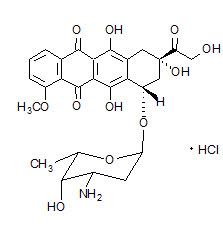
Doxorubicin. INDICATIONS AND USAGE Doxorubicin hydrochloride (HCl) is an anthracycline topoisomerase II inhibitor indicated: as a component of multiagent…
Boxed warning
WARNING: CARDIOMYOPATHY, SECONDARY MALIGNANCIES, EXTRAVASATION AND TISSUE NECROSIS, and SEVERE MYELOSUPPRESSION • Cardiomyopathy: Myocardial damage, including acute left ventricular failure, can occur with doxorubicin hydrochloride. The risk of cardiomyopathy is proportional to the cumulative exposure with incidence rates from 1%–20% for cumulative doses ranging from 300 mg/m 2 to 500 mg/m 2 when doxorubicin hydrochloride is administered every 3 weeks. The risk of cardiomyopathy is further increased with concomitant cardiotoxic therapy. Assess left ventricular ejection fraction (LVEF) before and regularly during and after treatment with doxorubicin hydrochloride [see Warnings and Precautions (5.1) ] . • Secondary Malignancies: Secondary acute myelogenous leukemia (AML) and myelodysplastic syndrome (MDS) occur at a higher incidence in patients treated with anthracyclines, including doxorubicin hydrochloride [see Warnings and Precautions (5.2) ] . • Extravasation and Tissue Necrosis: Extravasation of doxorubicin hydrochloride can result in severe local tissue injury and necrosis requiring wide excision of the affected area and skin grafting. Immediately terminate the drug and apply ice to the affected area [see Warnings and Precautions (5.3) ] . • Severe myelosuppression resulting in serious infection, septic shock, requirement for transfusions, hospitalization, and death may occur [see Warnings and Precautions (5.4) ] . WARNING: CARDIOMYOPATHY, SECONDARY MALIGNANCIES, EXTRAVASATION AND TISSUE NECROSIS, and SEVERE MYELOSUPPRESSION See full prescribing information for complete boxed warning. • Cardiomyopathy: Myocardial damage can occur with doxorubicin hydrochloride with incidences from 1%–20% for cumulative doses from 300 mg/m 2 to 500 mg/m 2 when doxorubicin hydrochloride is administered every 3 weeks. The risk of cardiomyopathy is further increased with concomitant cardiotoxic therapy. Assess left ventricular ejection fraction (LVEF) before and regularly during and after treatment with doxorubicin hydrochloride. ( 5.1 ) • Secondary Malignancies: Secondary acute myelogenous leukemia (AML) and myelodysplastic syndrome (MDS) occur at a higher incidence in patients treated with anthracyclines, including doxorubicin hydrochloride. ( 5.2 ) • Extravasation and Tissue Necrosis: Extravasation of doxorubicin hydrochloride can result in severe local tissue injury and necrosis requiring wide excision and skin grafting. Immediately terminate the drug, and apply ice to the affected area. ( 5.3 ) • Severe myelosuppression resulting in serious infection, septic shock, requirement for transfusions, hospitalization, and death may occur. ( 5.4 )
INDICATIONS AND USAGE Doxorubicin hydrochloride (HCl) is an anthracycline topoisomerase II inhibitor indicated: as a component of multiagent adjuvant chemotherapy for treatment of women with axillary lymph node involvement following resection of primary breast cancer (1.1). for the treatment of: acute lymphoblastic leukemia, acute myeloblastic leukemia, Hodgkin lymphoma, Non-Hodgkin lymphoma, metastatic breast cancer, metastatic Wilms’ tumor, metastatic neuroblastoma, metastatic soft tissue sarcoma, metastatic bone sarcomas, metastatic ovarian carcinoma, metastatic transitional cell bladder carcinoma, metastatic thyroid carcinoma, metastatic gastric carcinoma, metastatic bronchogenic carcinoma (1.2). 1.1 Adjuvant Breast Cancer DOXOrubicin hydrochloride injection, USP is indicated as a c omponent of multi-a gent adjuvant chemotherapy for treat ment of wo men with axillary lymph node involve ment following resection of pri mary breast cancer [see Clinical Studies (14.1 ) ]. 1.2 Other Cancers DOXOrubicin hydrochloride injection, USP is indicated for the treat ment of acute ly mphoblastic leu ke mia acute m yeloblastic leuke mia Hodgkin lympho ma non-Hodgkin ly mpho ma (NHL) metastatic breast cancer metastatic Wil ms’ tumor metastatic neurobla stoma metastatic s oft tissue sa rco ma metastatic bone sarco ma metastatic o varian car cino ma metastatic t ransitional c ell bladder carcino ma metastatic t hyroid carcinoma metastatic gastric carcinoma metastatic bronchogenic carcinoma
Dosage
DOSAGE AND ADMINISTRATION Administer doxorubicin hydrochloride liposome injection at an initial rate of 1 mg/min to minimize the risk of infusion reactions. If no infusion-related reactions occur, increase rate of infusion to complete administration over 1 hour. Do not administer as bolus injection or undiluted solution ( 2 ). Ovarian cancer: 50 mg/m 2 intravenously every 4 weeks ( 2.2 ) AIDS-related Kaposi's Sarcoma: 20 mg/m 2 intravenously every 3 weeks ( 2.3 ) Multiple Myeloma: 30 mg/m 2 intravenously on day 4 following bortezomib ( 2.4 ) 2.1 Important Use Information Do not substitute doxorubicin hydrochloride liposome injection for other doxorubicin hydrochloride products. Do not administer as an undiluted suspension or as an intravenous bolus [see Warnings and Precautions ( 5.2 )] . 2.2 Ovarian Cancer The recommended dose of doxorubicin hydrochloride liposome injection is 50 mg/m 2 intravenously over 60 minutes every 28 days until disease progression or unacceptable toxicity. 2.3 AIDS-Related Kaposi’s Sarcoma The recommended dose of doxorubicin hydrochloride liposome injection is 20 mg/m 2 intravenously over 60 minutes every 21 days until disease progression or unacceptable toxicity. 2.4 Multiple Myeloma The recommended dose of doxorubicin hydrochloride liposome injection is 30 mg/m 2 intravenously over 60 minutes on day 4 of each 21-day cycle for eight cycles or until disease progression or unacceptable toxicity. Administer doxorubicin hydrochloride liposome injection after bortezomib on day 4 of each cycle [see Clinical Studies ( 14.3 )] . 2.5 Dose Modifications for Adverse Reactions Do not increase doxorubicin hydrochloride liposome injection after a dose reduction for toxicity. Table 1: Recommended Dose Modifications for Hand-Foot Syndrome, Stomatitis, or Hematologic Adverse Reactions Toxicity Dose Adjustment Hand-Foot Syndrome (HFS) Grade 1: Mild erythema, swelling, or desquamation not interfering with daily activities If no previous Grade 3 or 4 HFS: no dose adjustment. If previous Grade 3 or 4 HFS: delay dose up to 2 weeks, then decrease dose by 25%. Grade 2: Erythema, desquamation, or swelling interfering with, but not precluding normal physical activities; small blisters or ulcerations less than 2 cm in diameter Delay dosing up to 2 weeks or until resolved to Grade 0-1. Discontinue doxorubicin hydrochloride liposome injection if no resolution after 2 weeks. If resolved to Grade 0-1 within 2 weeks: o And no previous Grade 3 or 4 HFS: continue treatment at previous dose. o And previous Grade 3 or 4 toxicity: decrease dose by 25%. Grade 3: Blistering, ulceration, or swelling interfering with walking or normal daily activities; cannot wear regular clothing Delay dosing up to 2 weeks or until resolved to Grade 0-1, then decrease dose by 25%. Discontinue doxorubicin hydrochloride liposome injection if no resolution after 2 weeks. Grade 4: Diffuse or local process causing infectious complications, or a bed ridden state or hospitalization Delay dosing up to 2 weeks or until resolved to Grade 0-1, then decrease dose by 25%. Discontinue doxorubicin hydrochloride liposome injection if no resolution after 2 weeks. Stomatitis Grade 1: Painless ulcers, erythema, or mild soreness If no previous Grade 3 or 4 toxicity: no dose adjustment. If previous Grade 3 or 4 toxicity: delay up to 2 weeks then decrease dose by 25%. Grade 2: Painful erythema, edema, or ulcers, but can eat Delay dosing up to 2 weeks or until resolved to Grade 0-1. Discontinue doxorubicin hydrochloride liposome injection if there is no resolution after 2 weeks. If resolved to Grade 0-1 within 2 weeks: o And no previous Grade 3 or 4 stomatitis: resume treatment at previous dose. o And previous Grade 3 or 4 toxicity: decrease dose by 25%. Grade 3: Painful erythema, edema, or ulcers, and cannot eat Delay dosing up to 2 weeks or until resolved to Grade 0-1. Decrease dose by 25% and return to original dose interval. If after 2 weeks there is no resolution, discontinue doxorubicin hydrochloride liposome injection. Grade 4: Requires parenteral or enteral support Delay dosing up to 2 weeks or until resolved to Grade 0-1. Decrease dose by 25% and return to original dose interval. If after 2 weeks there is no resolution, discontinue doxorubicin hydrochloride liposome injection. Neutropenia or Thrombocytopenia Grade 1 No dose reduction Grade 2 Delay until ANC ≥ 1,500 and platelets ≥ 75,000; resume treatment at previous dose Grade 3 Delay until ANC ≥ 1,500 and platelets ≥ 75,000; resume treatment at previous dose Grade 4 Delay until ANC ≥ 1,500 and platelets ≥ 75,000; resume at 25% dose reduction or continue previous dose with prophylactic granulocyte growth factor Table 2: Recommended Dose Modifications of Doxorubicin Hydrochloride Liposome Injection for Toxicity When Administered in Combination With Bortezomib Toxicity Doxorubicin Hydrochloride Liposome Injection Fever ≥38°C and ANC <1,000/mm 3 Withhold dose for this cycle if before Day 4; Decrease dose by 25%, if after Day 4 of previous cycle. On any day of drug administration after Day 1 of each cycle: Platelet count <25,000/mm 3 Hemoglobin <8 g/dL ANC <500/mm 3 Withhold dose for this cycle if before Day 4; Decrease dose by 25%, if after Day 4 of previous cycle AND if bortezomib is reduced for hematologic toxicity. Grade 3 or 4 non-hematologic drug related toxicity Do not dose until recovered to Grade <2, then reduce dose by 25%. For neuropathic pain or peripheral neuropathy, no dosage adjustments are required for doxorubicin hydrochloride liposome injection. Refer to bortezomib manufacturer's prescribing information. 2.6 Preparation and Administration Preparation Dilute doxorubicin hydrochloride liposome injection doses up to 90 mg in 250 mL of 5% Dextrose Injection, USP prior to administration. Dilute doses exceeding 90 mg in 500 mL of 5% Dextrose Injection, USP prior to administration. Refrigerate diluted doxorubicin hydrochloride liposome injection at 2°C to 8°C (36°F to 46°F) and administer within 24 hours. Discard unused portion. Administration Inspect parenteral drug products visually for particulate matter and discoloration prior to administration, whenever solution and container permit. Do not use if a precipitate or foreign matter is present. Do not use with in-line filters. Administer the first dose of doxorubicin hydrochloride liposome injection at an initial rate of 1 mg/min. If no infusion-related adverse reactions are observed, increase the infusion rate to complete the administration of the drug over one hour [see Warnings and Precautions (5.2)]. Do not rapidly flush the infusion line. Do not mix doxorubicin hydrochloride liposome injection with other drugs. Management of Suspected Extravasation Discontinue doxorubicin hydrochloride liposome injection for burning or stinging sensation or other evidence indicating perivenous infiltration or extravasation. Manage confirmed or suspected extravasation as follows: Do not remove the needle until attempts are made to aspirate extravasated fluid Do not flush the line Avoid applying pressure to the site Apply ice to the site intermittently for 15 minutes 4 times a day for 3 days If the extravasation is in an extremity, elevate the extremity 2.7 Procedure for Proper Handling and Disposal Doxorubicin hydrochloride liposome injection is a cytotoxic drug. Follow applicable special handling and disposal procedures. 1 If doxorubicin hydrochloride liposome injection comes into contact with skin or mucosa, immediately wash thoroughly with soap and water.
Warnings
WARNINGS AND PRECAUTIONS • Radiation-Induced Toxicity : Can be increased by the administration of Doxorubicin Hydrochloride Injection. Radiation recall can occur in patients who receive Doxorubicin Hydrochloride Injection after prior radiation therapy. ( 5.7 ) • Embryo-Fetal Toxicity : Can cause fetal harm. Advise females of reproductive potential of the potential risk to a fetus and on the use of effective contraception. Advise males with female partners of reproductive potential to use effective contraception. Advise males with pregnant partners to use condoms. ( 5.8 , 8.1 , 8.3 ) 5.1 Cardiomyopathy and Arrhythmias Cardiomyopathy Doxorubicin hydrochloride can result in myocardial damage, including acute left ventricular failure. The risk of cardiomyopathy is generally proportional to the cumulative exposure. Include prior doses of other anthracyclines or anthracenediones in calculations of total cumulative dosage for doxorubicin hydrochloride. Cardiomyopathy may develop during treatment or up to several years after completion of treatment and can include decrease in LVEF and signs and symptoms of congestive heart failure (CHF). The probability of developing cardiomyopathy is estimated to be 1 to 2% at a total cumulative dose of 300 mg/m 2 of doxorubicin hydrochloride, 3 to 5% at a dose of 400 mg/m 2 , 5 to 8% at a dose of 450 mg/m 2 , and 6 to 20% at a dose of 500 mg/m 2 , when doxorubicin hydrochloride is administered every 3 weeks. There is an additive or potentially synergistic increase in the risk of cardiomyopathy in patients who have received radiotherapy to the mediastinum or concomitant therapy with other known cardiotoxic agents, such as cyclophosphamide and trastuzumab. Pericarditis and myocarditis have also been reported during or following doxorubicin hydrochloride treatment. Assess left ventricular cardiac function (e.g., MUGA or echocardiogram) prior to initiation of Doxorubicin Hydrochloride Injection, during treatment to detect acute changes, and after treatment to detect delayed cardiotoxicity. Increase the frequency of assessments as the cumulative dose exceeds 300 mg/m 2 . Use the same method of assessment of LVEF at all time points [see Use in Specific Populations (8.4) ] . Discontinue Doxorubicin Hydrochloride Injection in patients who develop signs or symptoms of cardiomyopathy [see Dosage and Administration (2.3) ] . Consider the use of dexrazoxane to reduce the incidence and severity of cardiomyopathy due to doxorubicin hydrochloride administration in patients who have received a cumulative doxorubicin hydrochloride dose of 300 mg/m 2 and who will continue to receive doxorubicin hydrochloride. Arrhythmias Doxorubicin hydrochloride can result in arrhythmias, including life-threatening arrhythmias, during or within a few hours after doxorubicin hydrochloride administration and at any time point during treatment. Tachyarrhythmias, including sinus tachycardia, premature ventricular contractions, and ventricular tachycardia, as well as bradycardia, can occur. Electrocardiographic changes, including non-specific ST-T wave changes, atrioventricular and bundle-branch block can also occur. These electrocardiographic changes may be transient and self-limited and may not require a dosage modification of doxorubicin hydrochloride. 5.2 Secondary Malignancies The risk of developing secondary acute myelogenous leukemia (AML) and myelodysplastic syndrome (MDS) is increased following treatment with doxorubicin hydrochloride. Cumulative incidences ranged from 0.2% at five years to 1.5% at 10 years in two separate trials involving the adjuvant treatment of women with breast cancer. These leukemias generally occur within 1 to 3 years of treatment. 5.3 Extravasation and Tissue Necrosis Extravasation of doxorubicin hydrochloride can cause severe local tissue injury manifesting as blistering, ulceration, and necrosis requiring wide excision of the affected area and skin grafting. Extravasation should be considered if a patient experiences a burning or stinging sensation or shows other evidence indicating peri-venous infiltration or extravasation; however, extravasation may be present in patients who do not experience a stinging or burning sensation or when blood return is present on aspiration of the infusion needle. When given via a peripheral venous line, infuse Doxorubicin Hydrochloride Injection over 10 minutes or less to minimize the risk of thrombosis or perivenous extravasation. If extravasation is suspected, immediately discontinue the intravenous injection or continuous intravenous infusion [see Dosage and Administration (2.5) ] . Apply ice to the site intermittently for 15 minutes, 4 times a day for 3 days. In adults, if appropriate, administer dexrazoxane at the site of extravasation as soon as possible and within the first 6 hours after extravasation. 5.4 Severe Myelosuppression Doxorubicin hydrochloride can cause myelosuppression. In Study 1, the incidence of severe myelosuppression was: grade 4 leukopenia (0.3%), grade 3 leukopenia (3%), and grade 4 thrombocytopenia (0.1%). A dose-dependent, reversible neutropenia is the predominant manifestation of myelosuppression from doxorubicin hydrochloride. When doxorubicin hydrochloride is administered every 21 days, the neutrophil count reaches its nadir 10 to 14 days after administration with recovery usually occurring by day 21. Obtain complete blood counts prior to each treatment and carefully monitor patients during treatment for possible clinical complications due to myelosuppression. Delay next dose of Doxorubicin Hydrochloride Injection if severe myelosuppression has not improved. Consider dose reduction for patients with prolonged myelosuppression based on severity of reaction. 5.5 Use in Patients with Hepatic Impairment The clearance of doxorubicin is decreased in patients with elevated serum bilirubin with an increased risk of toxicity [see Use in Specific Populations (8.6) , Clinical Pharmacology (12.3) ] . Doxorubicin Hydrochloride Injection is contraindicated in patients with severe hepatic impairment (defined as Child Pugh Class C or serum bilirubin level greater than 5 mg/dL) [see Contraindications (4) ]. Reduce the dose of Doxorubicin Hydrochloride Injection in patients with serum bilirubin levels of 1.2 to 5 mg/dL [see Dosage and Administration (2.4) ] . Obtain liver tests including ALT, AST, alkaline phosphatase, and bilirubin prior to and during therapy. 5.6 Tumor Lysis Syndrome Doxorubicin hydrochloride can induce tumor lysis syndrome in patients with rapidly growing tumors. Evaluate blood uric acid levels, potassium, calcium, phosphate, and creatinine after initial treatment. Hydration, urine alkalinization, and prophylaxis with allopurinol to prevent hyperuricemia may minimize potential complications of tumor lysis syndrome. 5.7 Potentiation of Radiation Toxicity and Radiation Recall Doxorubicin hydrochloride can increase radiation-induced toxicity to the myocardium, mucosa, skin, and liver. Radiation recall, including but not limited to cutaneous and pulmonary toxicity, can occur in patients who receive doxorubicin hydrochloride after prior radiation therapy. 5.8 Embryo-Fetal Toxicity Based on findings in animals and its mechanism of action, Doxorubicin Hydrochloride Injection can cause fetal harm when administered to a pregnant woman; avoid the use of Doxorubicin Hydrochloride Injection during the 1 st trimester. Available human data do not establish the presence or absence of major birth defects and miscarriage related to the use of doxorubicin hydrochloride during the 2 nd and 3 rd trimesters. Doxorubicin hydrochloride was teratogenic and embryotoxic in rats and rabbits at doses lower than the recommended human dose. Advise pregnant women of the potential risk to a fetus. Advise females of reproductive potential to use effective contraception during treatment with Doxorubicin Hydrochloride Injection and for 6 months after treatment. Advise males with female partne
Contraindications
CONTRAINDICATIONS Doxorubicin Hydrochloride Injection are contraindicated in patients with: • Severe myocardial insufficiency [see Warnings and Precautions (5.1) ] • Recent (occurring within the past 4–6 weeks) myocardial infarction [see Warnings and Precautions (5.1) ] • Severe persistent drug-induced myelosuppression [see Warnings and Precautions (5.4) ] • Severe hepatic impairment (defined as Child Pugh Class C or serum bilirubin level greater than 5 mg/dL) [see Warnings and Precautions (5.5) ] • Severe hypersensitivity reaction to doxorubicin hydrochloride, including anaphylaxis [see Adverse Reactions (6.2) ] • Severe myocardial insufficiency ( 4 ) • Recent myocardial infarction ( 4 ) • Severe persistent drug-induced myelosuppression ( 4 ) • Severe hepatic impairment ( 4 ) • Severe hypersensitivity to doxorubicin hydrochloride ( 4 )
Drug interactions
DRUG INTERACTIONS Avoid concomitant use of doxorubicin hydrochloride with inhibitors and inducers of CYP3A4, CYP2D6, and/or P-gp ( 7.1 ). Do not administer doxorubicin hydrochloride in combination with trastuzumab due to increased risk of cardiac dysfunction ( 5.1 , 7.2 ). 7.1 Effect of Other Drugs on Doxorubicin Hydrochloride Injection Inhibitors of CYP3A4, CYP2D6, and P-gp Concomitant use of doxorubicin hydrochloride with inhibitors of CYP3A4, CYP2D6, or P-glycoprotein (P-gp), increased concentrations of doxorubicin hydrochloride, which may increase the incidence and severity of adverse reactions of doxorubicin hydrochloride. Avoid concomitant use of Doxorubicin Hydrochloride Injection with inhibitors of CYP3A4, CYP2D6, or P-gp. Inducers of CYP3A4, CYP2D6, or P-gp Concomitant use of doxorubicin hydrochloride with inducers of CYP3A4, CYP2D6, or P-gp may decrease the concentration of doxorubicin hydrochloride. Avoid concomitant use of Doxorubicin Hydrochloride Injection with inducers of CYP3A4, CYP2D6, or P-gp. Paclitaxel Paclitaxel, when given prior to doxorubicin hydrochloride, increases the plasma-concentrations of doxorubicin hydrochloride and its metabolites. Administer Doxorubicin Hydrochloride Injection prior to paclitaxel if used concomitantly. 7.2 Concomitant Use of Trastuzumab Concomitant use of trastuzumab and doxorubicin hydrochloride results in an increased risk of cardiac dysfunction. Avoid concomitant administration of Doxorubicin Hydrochloride Injection and trastuzumab [see Warnings and Precautions ( 5.1 )] . Patients receiving doxorubicin hydrochloride after stopping treatment with trastuzumab may also be at an increased risk of developing cardiotoxicity. Trastuzumab may persist in the circulation for up to 7 months. Therefore, avoid anthracycline-based therapy for up to 7 months after stopping trastuzumab when possible. If anthracyclines are used before this time, carefully monitor cardiac function. 7.3 Concomitant Use of Dexrazoxane Do not administer dexrazoxane as a cardioprotectant at the initiation of doxorubicin hydrochloride-containing chemotherapy regimens. In a randomized trial in women with metastatic breast cancer, initiation of dexrazoxane with doxorubicin hydrochloride-based chemotherapy resulted in a significantly lower tumor response rate (48% vs. 63%; p=0.007) and shorter time to progression compared to doxorubicin hydrochloride-based chemotherapy alone. 7.4 Concomitant Use of 6-Mercaptopurine Doxorubicin hydrochloride may potentiate 6-mercaptopurine-induced hepatotoxicity. In 11 patients with refractory leukemia treated with 6-mercaptopurine (500 mg/m 2 intravenously daily for 5 days per cycle every 2 to 3 weeks) and doxorubicin hydrochloride (50 mg/m 2 intravenous once per cycle every 2 to 3 weeks) alone or with vincristine and prednisone, all developed hepatic dysfunction manifested by increased total serum bilirubin, alkaline phosphatase and aspartate aminotransferase.
Adverse reactions
ADVERSE REACTIONS The following adverse reactions are discussed in more detail in other sections of the labeling. Cardiomyopathy [ see Warnings and Precautions ( 5.1 ) ] Infusion-Related Reactions [ see Warnings and Precautions ( 5.2 ) ] Hand-Foot Syndrome [ see Warnings and Precautions ( 5.3 ) ] Secondary Oral Neoplasms [ see Warnings and Precautions ( 5.4 ) ] Most common adverse reactions (>20%) are asthenia, fatigue, fever, anorexia, nausea, vomiting, stomatitis, diarrhea, constipation, hand-foot syndrome, rash, neutropenia, thrombocytopenia, and anemia ( 6 ). To report SUSPECTED ADVERSE REACTIONS, contact Dr. Reddy's Laboratories, Inc. at 1-888-375-3784 or FDA at 1-800-FDA-1088 or www.fda.gov/medwatch 6.1 Clinical Trials Experience Because clinical trials are conducted under widely varying conditions, the adverse reaction rates observed cannot be directly compared to rates on other clinical trials and may not reflect the rates observed in clinical practice. The safety data reflect exposure to doxorubicin hydrochloride liposome injection in 1310 patients including: 239 patients with ovarian cancer, 753 patients with AIDS-related Kaposi’s sarcoma, and 318 patients with multiple myeloma. The most common adverse reactions (>20%) observed with doxorubicin hydrochloride liposome injection are asthenia, fatigue, fever, nausea, stomatitis, vomiting, diarrhea, constipation, anorexia, hand-foot syndrome, rash and neutropenia, thrombocytopenia and anemia. The following tables present adverse reactions from clinical trials of single-agent doxorubicin hydrochloride liposome injection in ovarian cancer and AIDS-Related Kaposi’s sarcoma. Patients With Ovarian Cancer The safety data described below are from Trial 4, which included 239 patients with ovarian cancer treated with doxorubicin hydrochloride liposome injection 50 mg/m 2 once every 4 weeks for a minimum of four courses in a randomized, multicenter, open-label study. In this trial, patients received doxorubicin hydrochloride liposome injection for a median number of 3.2 months (range 1 day to 25.8 months). The median age of the patients is 60 years (range 27 to 87), with 91% Caucasian, 6% Black, and 3% Hispanic or Other. Table 3 presents the hematologic adverse reactions from Trial 4. Table 3: Hematologic Adverse Reactions in Trial 4 Doxorubicin hydrochloride Liposome Injection Patients (n=239) Topotecan Patients (n=235) Neutropenia 500 - <1000/mm 3 8% 14% <500/mm 3 4.2% 62% Anemia 6.5 - <8 g/dL 5% 25% < 6.5 g/dL 0.4% 4.3% Thrombocytopenia 10,000 - <50,000/mm 3 1.3% 17% <10,000/mm 3 0.0% 17% Table 4 presents the non-hematologic adverse reactions from Trial 4. Table 4: Non-Hematologic Adverse Reactions in Trial 4 Non-Hematologic Adverse Reaction 10% or Greater Doxorubicin hydrochloride Liposome Injection (%) treated (n=239) Topotecan (%) treated (n=235) All grades Grades 3-4 All grades Grades 3-4 Body as a Whole Asthenia 40 7 52 8 Fever 21 0.8 31 6 Mucous Membrane Disorder 14 3.8 3.4 0 Back Pain 12 1.7 10 0.9 Infection 12 2.1 6 0.9 Headache 11 0.8 15 0 Digestive Nausea 46 5 63 8 Stomatitis 41 8 15 0.4 Vomiting 33 8 44 10 Diarrhea 21 2.5 35 4.2 Anorexia 20 2.5 22 1.3 Dyspepsia 12 0.8 14 0 Nervous Dizziness 4.2 0 10 0 Respiratory Pharyngitis 16 0 18 0.4 Dyspnea 15 4.1 23 4.3 Cough increased 10 0 12 0 Skin and Appendages Hand-foot syndrome 51 24 0.9 0 Rash 29 4.2 12 0.4 Alopecia 19 N/A 52 N/A The following additional adverse reactions were observed in patients with ovarian cancer with doses administered every four weeks (Trial 4). Incidence 1% to 10% Cardiovascular: vasodilation, tachycardia, deep vein thrombosis, hypotension, cardiac arrest. Digestive : oral moniliasis, mouth ulceration, esophagitis, dysphagia, rectal bleeding, ileus. Hematologic and Lymphatic : ecchymosis. Metabolic and Nutritional: dehydration, weight loss, hyperbilirubinemia, hypokalemia, hypercalcemia, hyponatremia. Nervous : somnolence, dizziness, depression. Respiratory : rhinitis, pneumonia, sinusitis, epistaxis. Skin and Appendages : pruritus, skin discoloration, vesiculobullous rash, maculopapular rash, exfoliative dermatitis, herpes zoster, dry skin, herpes simplex, fungal dermatitis, furunculosis, acne. Special Senses : conjunctivitis, taste perversion, dry eyes. Urinary : urinary tract infection, hematuria, vaginal moniliasis. Patients With AIDS-Related Kaposi’s Sarcoma The safety data described is based on the experience reported in 753 patients with AIDS-related Kaposi’s sarcoma (KS) enrolled in four open-label, uncontrolled trials of doxorubicin hydrochloride liposome injection administered at doses ranging from 10 to 40 mg/m 2 every 2 to 3 weeks. Demographics of the population were: median age 38.7 years (range 24 to 70); 99% male; 88% Caucasian, 6% Hispanic, 4% Black, and 2% Asian/other/ unknown. The majority of patients were treated with 20 mg/m 2 of doxorubicin hydrochloride liposome injection every 2 to 3 weeks with a median exposure of 4.2 months (range 1 day to 26.6 months). The median cumulative dose was 120 mg/m 2 (range 3.3 to 798.6 mg/m 2 ); 3% received cumulative doses of greater than 450 mg/m 2 . Disease characteristics were: 61% poor risk for KS tumor burden, 91% poor risk for immune system, and 47% poor risk for systemic illness; 36% were poor risk for all three categories; median CD4 count 21 cells/mm3 (51% less than 50 cells/mm3); mean absolute neutrophil count at study entry approximately 3,000 cells/mm3. Of the 693 patients with concomitant medication information, 59% were on one or more antiretroviral medications [35% zidovudine (AZT), 21% didanosine (ddI), 16% zalcitabine (ddC), and 10% stavudine (D4T)]; 85% received PCP prophylaxis (54% sulfamethoxazole/trimethoprim); 85% received antifungal medications (76% fluconazole); 72% received antivirals (56% acyclovir, 29% ganciclovir, and 16% foscarnet) and 48% patients received colony-stimulating factors (sargramostim/filgrastim) during their course of treatment. Adverse reactions led to discontinuation of treatment in 5% of patients with AIDS-related Kaposi’s sarcoma and included myelosuppression, cardiac adverse reactions, infusion-related reactions, toxoplasmosis, HFS, pneumonia, cough/dyspnea, fatigue, optic neuritis, progression of a non-KS tumor, allergy to penicillin, and unspecified reasons. Tables 5 and 6 summarize adverse reactions reported in patients treated with doxorubicin hydrochloride liposome injection for AIDS-related Kaposi’s sarcoma in a pooled analysis of the four trials. Table 5: Hematologic Adverse Reactions Reported in Patients With AIDS-Related Kaposi’s Sarcoma Patients With Refractory or Intolerant AIDS-Related Kaposi’s Sarcoma (n=74*) Total Patients With AIDS-Related Kaposi’s Sarcoma (n=720**) Neutropenia < 1000/mm 3 46% 49% < 500/mm 3 11% 13% Anemia < 10 g/dL 58% 55% < 8 g/dL 16% 18% Thrombocytopenia < 150,000/mm 3 61% 61% < 25,000/mm 3 1.4% 4.2% * This includes a subset of subjects who were retrospectively identified as having disease progression on prior systemic combination chemotherapy (at least 2 cycles of a regimen containing at least 2 of 3 treatments: bleomycin, vincristine or vinblastine, or doxorubicin) or as being intolerant to such therapy. ** This includes only subjects with AIDS-KS who had available data from the 4 pooled trials. Table 6: Non-Hematologic Adverse Reactions Reported in ≥ 5% of Patients With AIDS-Related Kaposi’s Sarcoma Adverse Reactions Patients With Refractory or Intolerant AIDS-Related Kaposi’s Sarcoma (n=77*) Total Patients With AIDS-Related Kaposi’s Sarcoma (n=705**) Nausea 18% 17% Asthenia 7% 10% Fever 8% 9% Alopecia 9% 9% Alkaline Phosphatase Increase 1.3% 8% Vomiting 8% 8% Diarrhea 5% 8% Stomatitis 5% 7% Oral Moniliasis 1.3% 6% * This includes a subset of subjects who were retrospectively identified as having disease progression on prior systemic combination chemotherapy (at least 2 cycles of a regimen containing at least 2 of 3 treatments: bleomycin, vincristine or vinblastine, or doxorubicin)
Mechanism of action
Mechanism of Action The cytotoxic effect of doxorubicin hydrochloride on malignant cells and its toxic effects on various organs are thought to be related to nucleotide base intercalation and cell membrane lipid binding activities of doxorubicin hydrochloride. Intercalation inhibits nucleotide replication and action of DNA and RNA polymerases. The interaction of doxorubicin hydrochloride with topoisomerase II to form DNA-cleavable complexes appears to be an important mechanism of doxorubicin hydrochloride cytocidal activity.