Burosumab
Managing this medication for someone you care for? Eleplan keeps diagnoses, medications and appointments in one plan.
Start free with EleplanMedication reference
Burosumab
SUBCUTANEOUS
Burosumab. INDICATIONS AND USAGE CRYSVITA is a fibroblast growth factor 23 (FGF23) blocking antibody indicated for: The treatment of X-linked hypophosphatemia…
Brand names
CRYSVITA
Active ingredients
BUROSUMAB
Indications
INDICATIONS AND USAGE CRYSVITA is a fibroblast growth factor 23 (FGF23) blocking antibody indicated for: The treatment of X-linked hypophosphatemia (XLH) in adult and pediatric patients 6 months of age and older. ( 1.1 ) The treatment of FGF23-related hypophosphatemia in tumor-induced osteomalacia (TIO) associated with phosphaturic mesenchymal tumors that cannot be curatively resected or localized in adult and pediatric patients 2 years of age and older. ( 1.2 ) 1.1 X-linked Hypophosphatemia CRYSVITA is indicated for the treatment of X-linked hypophosphatemia (XLH) in adult and pediatric patients 6 months of age and older. 1.2 Tumor-induced Osteomalacia CRYSVITA is indicated for the treatment of FGF23-related hypophosphatemia in tumor-induced osteomalacia (TIO) associated with phosphaturic mesenchymal tumors that cannot be curatively resected or localized in adult and pediatric patients 2 years of age and older.
Dosage
DOSAGE AND ADMINISTRATION For subcutaneous use only ( 2 ) Prior to starting CRYSVITA, discontinue oral phosphate and/or active vitamin D analogs for one week ( 2.1 ) Pediatric XLH (6 months and older): For patients who weigh less than 10 kg, starting dose regimen is 1 mg/kg of body weight rounded to the nearest 1 mg, administered every two weeks ( 2.2 ) For patients who weigh 10 kg and greater, starting dose regimen is 0.8 mg/kg of body weight rounded to the nearest 10 mg, administered every two weeks. The minimum starting dose is 10 mg up to a maximum dose of 90 mg. ( 2.2 ) Dose may be increased up to approximately 2 mg/kg (maximum 90 mg), administered every two weeks to achieve normal serum phosphorus. ( 2.2 ) Adult XLH: Dose regimen is 1 mg/kg body weight rounded to the nearest 10 mg up to a maximum dose of 90 mg administered every four weeks. ( 2.3 ) Pediatric TIO (2 years and older): Starting dose is 0.4 mg/kg of body weight rounded to the nearest 10 mg every 2 weeks. Dose may be increased up to 2 mg/kg not to exceed 180 mg, administered every two weeks. ( 2.4 ) Adult TIO: Starting dose is 0.5 mg/kg every four weeks. Dose may be increased up to 2 mg/kg not to exceed 180 mg, administered every two weeks. ( 2.5 ) 2.1 Important Information Prior to Initiation of CRYSVITA Prior to starting CRYSVITA, discontinue oral phosphate and/or active vitamin D analogs (e.g. calcitriol, paricalcitol, doxercalciferol, calcifediol) for one week [see Contraindications (4) , Warnings and Precautions (5.3) ] . Prior to starting CRYSVITA, fasting serum phosphorus concentration should be below the reference range for age [see Contraindications (4) ]. In patients at high risk for hypercalcemia (e.g., pre-existing hyperparathyroidism, prolonged immobilization, dehydration, hypervitaminosis D, or renal impairment) assess serum calcium and parathyroid hormone levels prior to starting CRYSVITA [see Warnings and Precautions (5.3) ] . CRYSVITA is administered by subcutaneous injection and should be administered by a healthcare provider. The maximum volume of CRYSVITA per injection is 1.5 mL. If multiple injections are required, administer at different injection sites. 2.2 Recommended Dosage for Pediatric Patients with X-linked Hypophosphatemia (6 months to less than 18 years of age) For patients who weigh less than 10 kg, the recommended starting dosage is 1 mg/kg of body weight, rounded to the nearest 1 mg, administered every two weeks. For patients who weigh 10 kg and greater, the recommended starting dose regimen is 0.8 mg/kg of body weight, rounded to the nearest 10 mg, administered every two weeks. The minimum starting dose is 10 mg up to a maximum dose of 90 mg. After initiation of treatment with CRYSVITA, measure fasting serum phosphorus every 4 weeks for the first 3 months of treatment, and thereafter as appropriate. If serum phosphorus is above the lower limit of the reference range for age and below 5 mg/dL, continue treatment with the same dose. Follow dose adjustment schedule below to maintain serum phosphorus within the reference range for age. Dose Adjustment Reassess fasting serum phosphorus level 4 weeks after dose adjustment. Do not adjust CRYSVITA more frequently than every 4 weeks. Dose Increase : For patients who weigh less than 10 kg, if serum phosphorus is below the reference range for age, the dose may be increased to 1.5 mg/kg, rounded to the nearest 1 mg, administered every two weeks. If additional dose increases are needed, the dose may be increased to the maximum dose of 2 mg/kg, rounded to the nearest 1 mg, administered every two weeks. For patients who weigh 10 kg or greater, if serum phosphorus is below the reference range for age, the dose may be increased stepwise up to approximately 2 mg/kg, administered every two weeks (maximum dose of 90 mg) according to the dosing schedule shown in Table 1. Table 1: XLH Pediatric Dose Schedule for Stepwise Dose Increase for Patients Weighing 10 kg or More Body Weight (kg) Starting Dose (mg) First Dose Increase to (mg) Second Dose Increase to (mg) 10 – 14 10 15 20 15 – 18 10 20 30 19 – 31 20 30 40 32 – 43 30 40 60 44 – 56 40 60 80 57 – 68 50 70 90 69 – 80 60 90 90 81 – 93 70 90 90 94 – 105 80 90 90 106 and greater 90 90 90 Dose Decrease: If serum phosphorus is above 5 mg/dL, withhold the next dose and reassess the serum phosphorus level in 4 weeks. The patient must have serum phosphorus below the reference range for age to reinitiate CRYSVITA. Once serum phosphorus is below the reference range for age, treatment may be restarted. For patients who weigh less than 10 kg, restart CRYSVITA at 0.5 mg/kg of body weight, rounded to the nearest 1 mg, administered every two weeks. For patients who weigh 10 kg or more, restart CRYSVITA according to the dose schedule shown in Table 2. Table 2: XLH Pediatric Dose Schedule for Re-Initiation of Therapy for Patients Weighing 10 kg or More Previous Dose (mg) Re-Initiation Dose (mg) 10 5 15 10 20 10 30 10 40 20 50 20 60 30 70 30 80 40 90 40 After a dose decrease, reassess serum phosphorus level 4 weeks after the dose adjustment. If the level remains below the reference range for age after the re-initiation dose, the dose can be adjusted as outlined under Dose Increase. 2.3 Recommended Dosage for Adult Patients with X-linked Hypophosphatemia (18 years of age and older) The recommended dosage regimen in adults is 1 mg/kg body weight, rounded to the nearest 10 mg up to a maximum dose of 90 mg, administered every four weeks. After initiation of treatment with CRYSVITA, assess fasting serum phosphorus on a monthly basis, measured 2 weeks post-dose, for the first 3 months of treatment, and thereafter as appropriate. If serum phosphorus is within the normal range, continue with the same dose. Dose Decrease Reassess fasting serum phosphorus level 2 weeks after dose adjustment. Do not adjust CRYSVITA more frequently than every 4 weeks. If serum phosphorus is above the normal range, withhold the next dose and reassess the serum phosphorus level after 4 weeks. The patient must have serum phosphorus below the normal range to be able to reinitiate CRYSVITA. Once serum phosphorus is below the normal range, treatment may be restarted at approximately half the initial starting dose up to a maximum dose of 40 mg every 4 weeks according to the dose schedule shown in Table 3. Reassess serum phosphorus 2 weeks after any change in dose. Table 3: XLH Adult Dose Schedule for Re-Initiation of Therapy Previous Dose (mg) Re-Initiation Dose (mg) 40 20 50 20 60 30 70 30 80 and greater 40 2.4 Recommended Dosage for Pediatric Patients with Tumor-induced Osteomalacia (2 years to less than 18 years of age) The recommended starting dosage for pediatrics is 0.4 mg/kg body weight administered every 2 weeks, rounded to the nearest 10 mg, up to a maximum dose of 2 mg/kg not to exceed 180 mg, administered every 2 weeks. After initiation of treatment with CRYSVITA, assess fasting serum phosphorus on a monthly basis, measured 2 weeks post-dose, for the first 3 months of treatment, and thereafter as appropriate. If serum phosphorus is within the reference range for age, continue with the same dose. Follow the dose adjustment schedule below to maintain serum phosphorus within the reference range for age. Dose Adjustment Reassess fasting serum phosphorus level 4 weeks after dose adjustment. Do not adjust CRYSVITA more frequently than every 4 weeks. Dose Increase If serum phosphorus is below the reference range for age, the dose should be titrated in accordance with Table 4 up to the maximum dose of 2 mg/kg every 2 weeks. The maximum dose should not exceed 180 mg. Table 4: TIO Pediatric Dose Schedule for Stepwise Dose Increase for Patients Weighing 10 kg or more Body Weight (kg) Starting Dose (mg) First Dose Increase to (mg) Second Dose Increase to (mg) Third Dose The table shows a dose increase up to 1.5 mg/kg. Further dose increases to a maximum of 2 mg/kg not to exceed 180 mg, administered every 2 weeks should b
Warnings
WARNINGS AND PRECAUTIONS Hypersensitivity : Discontinue CRYSVITA if serious hypersensitivity reactions occur and initiate appropriate medical treatment. ( 5.1 ) Hyperphosphatemia and Risk of Nephrocalcinosis : For patients already taking CRYSVITA, dose interruption and/or dose reduction may be required based on a patient's serum phosphorus levels. ( 5.2 , 6.1 ) Hypercalcemia : Increases in serum calcium been reported. Monitor serum calcium and parathyroid hormone levels in patients at high risk for hypercalcemia before and during treatment. ( 5.3 ) Injection Site Reactions : Administration of CRYSVITA may result in local injection site reactions. Discontinue CRYSVITA if severe injection site reactions occur and administer appropriate medical treatment. ( 5.4 , 6.1 ) 5.1 Hypersensitivity Hypersensitivity reactions (e.g. rash, urticaria) have been reported in patients with CRYSVITA. Discontinue CRYSVITA if serious hypersensitivity reactions occur and initiate appropriate medical treatment [see Adverse Reactions (6.1) ] . 5.2 Hyperphosphatemia and Risk of Nephrocalcinosis Increases in serum phosphorus to above the upper limit of normal may be associated with an increased risk of nephrocalcinosis. For patients already taking CRYSVITA, dose interruption and/or dose reduction may be required based on a patient's serum phosphorus levels. Patients with tumor-induced osteomalacia who undergo treatment of the underlying tumor should have dosing interrupted and adjusted to prevent hyperphosphatemia [see Dosage and Administration (2) and Adverse Reactions (6.1) ] . 5.3 Hypercalcemia Increases in serum calcium have been reported in patients treated with CRYSVITA. Patients with risk factors such as, pre-existing hyperparathyroidism, prolonged immobilization, dehydration, hypervitaminosis D, or renal impairment, are at higher risk of hypercalcemia. Monitor these patients for serum calcium and parathyroid hormone levels before and during CRYSVITA treatment for moderate to severe hypercalcemia. In patients with moderate to severe hypercalcemia, CRYSVITA should not be administered until hypercalcemia is adequately managed. 5.4 Injection Site Reactions Administration of CRYSVITA may result in local injection site reactions. Discontinue CRYSVITA if severe injection site reactions occur and administer appropriate medical treatment [see Adverse Reactions (6.1) ] .
Contraindications
CONTRAINDICATIONS CRYSVITA is contraindicated: In concomitant use with oral phosphate and/or active vitamin D analogs (e.g. calcitriol, paricalcitol, doxercalciferol, calcifediol) due to the risk of hyperphosphatemia [see Warnings and Precautions (5.2) and Drug Interactions (7.1) ] . When serum phosphorus is within or above the normal range for age [see Warnings and Precautions (5.2) ] . In patients with severe renal impairment or end stage renal disease because these conditions are associated with abnormal mineral metabolism [see Use In Specific Population (8.6) ] . With oral phosphate and/or active vitamin D analogs. ( 4 ) When serum phosphorus is within or above the normal range for age. ( 4 ) In patients with severe renal impairment or end stage renal disease. ( 4 )
Drug interactions
DRUG INTERACTIONS 7.1 Oral Phosphate and Active Vitamin D Analogs Concomitant use of CRYSVITA with oral phosphate and/or active vitamin D analogs will increase phosphate concentrations greater than expected with CRYSVITA alone. This increase may result in hyperphosphatemia which can induce nephrocalcinosis. Concomitant use of CRYSVITA with oral phosphate and/or active vitamin D analogs is contraindicated.
Adverse reactions
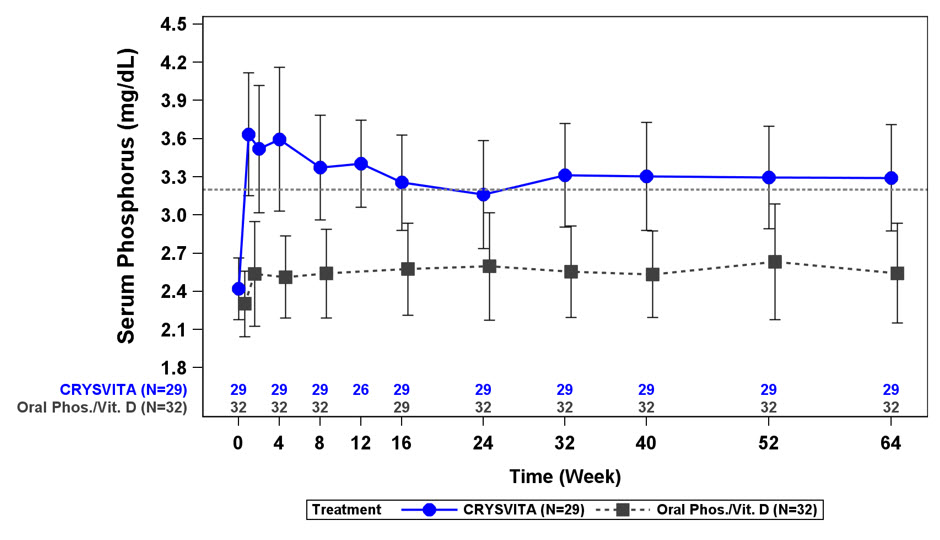
ADVERSE REACTIONS The following adverse reactions are described below and elsewhere in the labeling: Hypersensitivity [see Warnings and Precautions (5.1) ] Hyperphosphatemia and Risk of Nephrocalcinosis [see Warnings and Precautions (5.2) ] Hypercalcemia [see Warnings and Precautions (5.3) Injection Site Reactions [see Warnings and Precautions (5.4) ] Most common adverse reactions (≥25% in the CRYSVITA group and > Active Control) in pediatric XLH patients are: pyrexia, injection site reaction, cough, vomiting, pain in extremity, headache, tooth abscess, dental caries. ( 6.1 ) Most common adverse reactions (>5% and in at least 2 patients more than placebo) in adult XLH patients are: back pain, headache, tooth infection, restless legs syndrome, vitamin D decreased, dizziness, constipation, muscle spasms, blood phosphorus increased. ( 6.1 ) Most common adverse reactions (>10%) in TIO patients are: tooth abscess, muscle spasms, dizziness, constipation, injection site reaction, rash, and headache. ( 6.1 ) To report SUSPECTED ADVERSE REACTIONS, contact Kyowa Kirin, Inc. at 1-844-768-3544 or FDA at 1-800-FDA-1088 or www.fda.gov/medwatch . 6.1 Clinical Trials Experience Because clinical trials are conducted under widely varying conditions, adverse reaction rates observed in the clinical trials of a drug cannot be directly compared to rates in the clinical trials of another drug and may not reflect the rates observed in practice. Adverse Reactions in Pediatric Patients with XLH CRYSVITA was studied in three pediatric XLH studies. Study 1 is a randomized, open-label phase 3 study in XLH patients ages 1 to 12 years, who were randomized to treatment with CRYSVITA or treatment with active control of oral phosphate and active vitamin D (CRYSVITA N = 29, Active Control N = 32). Study 2 is an open-label phase 2 study in XLH patients ages 5 to 12 years (N = 52). Study 3 is an open-label phase 2 study in XLH patients ages 1 to less than 5 years (N = 13). Overall, the patient population was 1-12 years (mean age 7.0 years), 49% male, and 88% white. In Study 1, patients randomized to CRYSVITA received a mean dose of approximately 0.90 mg/kg (range 0.8-1.2 mg/kg) every 2 weeks. All patients in this group and the active control group completed 64 weeks of treatment. Adverse reactions occurring in ≥ 10% of subjects in the CRYSVITA group, with higher frequency than in the subjects in the active control group, through the 64-week treatment period in Study 1 are shown in Table 6 . Table 6: Adverse Reactions Reported in 10% or More of CRYSVITA-Treated Pediatric Patients and with Higher Frequency Than the Active Control Group in Study 1 Adverse Reaction CRYSVITA (N=29) n (%) Active Control (N=32) n (%) n = number of patients with an event; N = total number of patients who received at least one dose of CRYSVITA or active control Pyrexia 16 (55) 6 (19) Injection site reaction Injection site reaction includes: injection site reaction, injection site erythema, injection site pruritus, injection site swelling, injection site pain, injection site rash, injection site bruising, injection site discoloration, injection site discomfort, injection site hematoma, injection site hemorrhage, injection site induration, injection site macule, and injection site urticaria 15 (52) 0 (0) Cough Cough includes: cough and productive cough 15 (52) 6 (19) Vomiting 12 (41) 8 (25) Pain in extremity 11 (38) 10 (31) Headache 10 (34) 6 (19) Tooth abscess Tooth abscess includes: tooth abscess, tooth infection, toothache 10 (34) 4 (13) Dental caries 9 (31) 2 (6) Diarrhea 7 (24) 2 (6) Vitamin D decreased Vitamin D decreased includes: vitamin D deficiency, blood 25-hydroxycholecalciferol decreased, and vitamin D decreased 7 (24) 1 (3) Constipation 5 (17) 0 (0) Rash Rash includes: rash, rash pruritic, rash maculopapular, rash erythematous, rash generalized and rash pustular 4 (14) 2 (6) Nausea 3 (10) 1 (3) In Study 2, 26 of the patients received CRYSVITA at a mean dose of 1.05 mg/kg (range 0.4 – 2.0 mg/kg) every 2 weeks at Week 64; the other 26 patients received CRYSVITA every 4 weeks. The mean duration of exposure in Study 2 was 124 weeks. In Study 3, patients received CRYSVITA at a mean dose of 0.90 mg/kg (range 0.8-1.2 mg/kg) every 2 weeks at Week 40. The mean duration of exposure in Study 3 was 45 weeks. Adverse reactions occurring in more than 10% of CRYSVITA-treated patients from Studies 2 and 3 are shown in Table 7 . Table 7: Adverse Reactions Reported in More Than 10% of Pediatric Patients Receiving CRYSVITA in Studies 2 and 3 Adverse Reaction Study 2 (N=52) n (%) Study 3 (N=13) n (%) Overall (N=65) n (%) n = number of patients with an event; N = total number of patients who received at least one dose of CRYSVITA Headache 38 (73) 1 (8) 39 (60) Injection site reaction Injection site reaction includes: injection site reaction, injection site erythema, injection site pruritus, injection site swelling, injection site pain, injection site rash, injection site bruising, injection site discoloration, injection site discomfort, injection site hematoma, injection site hemorrhage, injection site induration, injection site macule, and injection site urticaria 35 (67) 3 (23) 38 (59) Vomiting 25 (48) 6 (46) 31 (48) Pyrexia 23 (44) 8 (62) 31 (48) Pain in extremity 24 (46) 3 (23) 27 (42) Vitamin D decreased Vitamin D decreased includes: vitamin D deficiency, blood 25-hydroxycholecalciferol decreased, and vitamin D decreased 19 (37) 2 (15) 21 (32) Rash Rash includes: rash, rash pruritic, rash maculopapular, and rash pustular 14 (27) 1 (8) 15 (23) Toothache 12 (23) 2 (15) 14 (22) Myalgia 9 (17) 1 (8) 10 (15) Tooth abscess 8 (15) 3 (23) 11 (17) Dizziness Dizziness includes: dizziness, and dizziness exertional 8 (15) 0 (0) 8 (12) Hypersensitivity Reactions In Study 1 (N=29 for CRYSVITA arm), the most frequent hypersensitivity reactions were rash (10%), injection site rash (10%) and injection site urticaria (7%). In Studies 2 and 3 (N=65), the most frequent hypersensitivity reactions were rash (22%), injection site rash (6%), and urticaria (5%). Hyperphosphatemia In pediatric studies, no events of hyperphosphatemia were reported. Injection Site Reactions (ISR) In Study 1 (N=29 for CRYSVITA arm), 52% of the patients had a local injection site reaction (e.g. injection site urticaria, erythema, rash, swelling, bruising, pain, pruritus, and hematoma) at the site of CRYSVITA injection. In Studies 2 and 3 (N=65), approximately 58% of the patients had a local injection site reaction at the site of CRYSVITA injection. Injection site reactions were generally mild in severity, occurred within 1 day of injection, lasted approximately 1 to 3 days, required no treatment, and resolved in almost all instances. Adverse Reactions in Adult Patients with XLH The safety of CRYSVITA in adult patients with XLH was demonstrated in a randomized, double-blind, placebo-controlled study (Study 4) of 134 patients, age 20-63 years (mean age 41 years), of whom most were white/Caucasian (81%) and female (65%). A total of 68 and 66 patients received at least one dose of CRYSVITA or placebo, respectively. The mean dose of CRYSVITA was 0.95 mg/kg (range 0.3 – 1.2 mg/kg) subcutaneously every 4 weeks. Adverse reactions reported in more than 5% of CRYSVITA-treated patients and 2 patients or more than with placebo from the 24-week placebo-controlled portion of Study 4 are shown in Table 8 . Table 8: Adverse Reactions Occurring in More Than 5% of CRYSVITA-Treated Adult Patients and in at Least 2 Patients More Than with Placebo in the 24-Week Placebo-Controlled Period of Study 4 Adverse Reaction CRYSVITA (N=68) n (%) Placebo (N=66) n (%) n = number of patients with an event; N = total number of patients who received at least one dose of CRYSVITA or placebo Back pain 10 (15) 6 (9) Headache Headache includes: headache, and head discomfort 9 (13) 6 (9) Tooth infection Tooth infection includes: tooth abscess, and tooth infection 9 (13) 6 (9) Restless legs syndrome
Mechanism of action
Mechanism of Action X-linked hypophosphatemia is caused by excess fibroblast growth factor 23 (FGF23) which suppresses renal tubular phosphate reabsorption and the renal production of 1,25 dihydroxy vitamin D. Burosumab-twza binds to and inhibits the biological activity of FGF23 restoring renal phosphate reabsorption and increasing the serum concentration of 1,25 dihydroxy vitamin D.
NDC examples
42747-10242747-20342747-304
Indicated ICD-10 codes
Treats these conditions
Source: openFDA + RxNorm · 2026
Look up another medication