Acetazolamide Extended-release
Managing this medication for someone you care for? Eleplan keeps diagnoses, medications and appointments in one plan.
Start free with EleplanMedication reference
Acetazolamide Extended-release
Carbonic Anhydrase Inhibitor [EPC] — ORAL
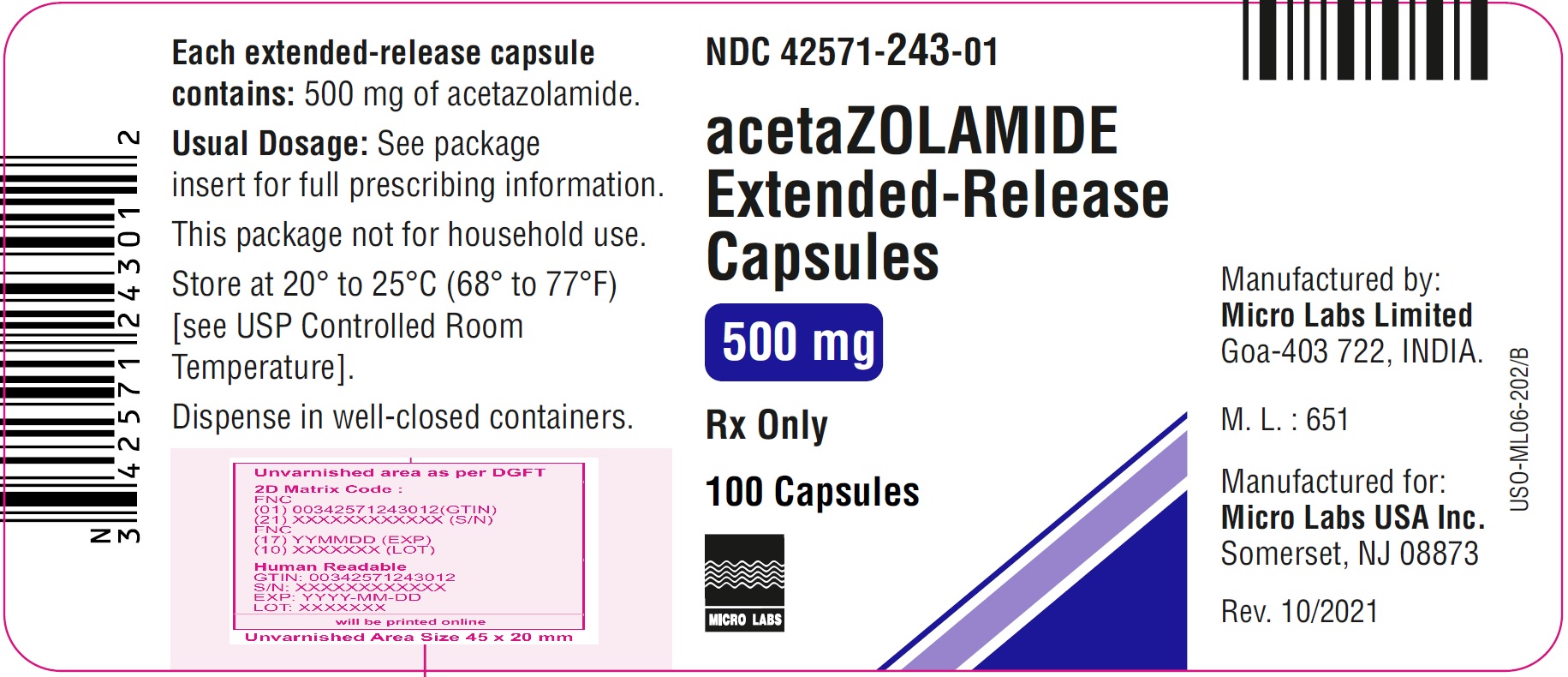
Acetazolamide Extended-release — Carbonic Anhydrase Inhibitor [EPC]. INDICATIONS AND USAGE: For adjunctive treatment of: chronic simple (open-angle) glaucoma, secondary glaucoma, and preoperatively in acute…
Brand names
ACETAZOLAMIDE EXTENDED-RELEASE
Active ingredients
ACETAZOLAMIDE
Indications
INDICATIONS AND USAGE: For adjunctive treatment of: chronic simple (open-angle) glaucoma, secondary glaucoma, and preoperatively in acute angle-closure glaucoma where delay of surgery is desired in order to lower intraocular pressure. Acetazolamide extended-release capsules are also indicated for the prevention or amelioration of symptoms associated with acute mountain sickness despite gradual ascent.
Dosage
DOSAGE AND ADMINISTRATION: Glaucoma The recommended dosage is 1 capsule (500 mg) two times a day. Usually 1 capsule is administered in the morning and 1 capsule in the evening. It may be necessary to adjust the dose, but it has usually been found that dosage in excess of 2 capsules (1 g) does not produce an increased effect. The dosage should be adjusted with careful individual attention both to symptomatology and intraocular tension. In all cases, continuous supervision by a physician is advisable. In those unusual instances where adequate control is not obtained by the twice-a-day administration of acetazolamide extended-release capsules, USP the desired control may be established by means of acetazolamide (tablets or parenteral). Use tablets or parenteral in accordance with the more frequent dosage schedules recommended for these dosage forms, such as 250 mg every four hours, or an initial dose of 500 mg followed by 250 mg or 125 mg every four hours, depending on the case in question. Acute Mountain Sickness Dosage is 500 mg to 1000 mg daily, in divided doses using tablets or extended-release capsules as appropriate. In circumstances of rapid ascent, such as in rescue or military operations, the higher dose level of 1000 mg is recommended. It is preferable to initiate dosing 24 to 48 hours before ascent and to continue for 48 hours while at high altitude, or longer as necessary to control symptoms.
Warnings
WARNINGS: Fatalities have occurred, although rarely, due to severe reactions to sulfonamides including Stevens-Johnson syndrome, toxic epidermal necrolysis, fulminant hepatic necrosis, anaphylaxis, agranulocytosis, aplastic anemia, and other blood dyscrasias. Sensitizations may recur when a sulfonamide is readministered irrespective of the route of administration. If signs of hypersensitivity or other serious reactions occur, discontinue use of this drug. Caution is advised for patients receiving concomitant high-dose aspirin and acetazolamide, as anorexia, tachypnea, lethargy, metabolic acidosis, coma, and death have been reported.
Contraindications
CONTRAINDICATIONS: Hypersensitivity to acetazolamide or any excipients in the formulation. Since acetazolamide is a sulfonamide derivative, cross sensitivity between acetazolamide, sulfonamides and other sulfonamide derivatives is possible. Acetazolamide therapy is contraindicated in situations in which sodium and/or potassium blood serum levels are depressed, in cases of marked kidney and liver disease or dysfunction, in suprarenal gland failure, and in hyperchloremic acidosis. It is contraindicated in patients with cirrhosis because of the risk of development of hepatic encephalopathy. Long-term administration of acetazolamide is contraindicated in patients with chronic non-congestive angle-closure glaucoma since it may permit organic closure of the angle to occur while the worsening glaucoma is masked by lowered intraocular pressure.
Drug interactions
Drug Interactions Aspirin - See WARNINGS Acetazolamide modifies phenytoin metabolism with increased serum levels of phenytoin. This may increase or enhance the occurrence of osteomalacia in some patients receiving chronic phenytoin therapy. Caution is advised in patients receiving chronic concomitant therapy. By decreasing the gastrointestinal absorption of primidone, acetazolamide may decrease serum concentrations of primidone and its metabolites, with a consequent possible decrease in anticonvulsant effect. Caution is advised when beginning, discontinuing, or changing the dose of acetazolamide in patients receiving primidone. Because of possible additive effects with other carbonic anhydrase inhibitors, concomitant use is not advisable. Acetazolamide may increase the effects of other folic acid antagonists. Acetazolamide decreases urinary excretion of amphetamine and may enhance the magnitude and duration of their effect. Acetazolamide reduces urinary excretion of quinidine and may enhance its effect. Acetazolamide may prevent the urinary antiseptic effect of methenamine. Acetazolamide increases lithium excretion and the lithium may be decreased. Acetazolamide and sodium bicarbonate used concurrently increase the risk of renal calculus formation. Acetazolamide may elevate cyclosporine levels.
Adverse reactions
ADVERSE REACTIONS: Body as a whole: Headache, malaise, fatigue, fever, pain at injection site, flushing, growth retardation in children, flaccid paralysis, anaphylaxis. Digestive: Gastrointestinal disturbances such as nausea, vomiting, diarrhea. Hematological/Lymphatic: Blood dyscrasias such as aplastic anemia, agranulocytosis, leukopenia, thrombocytopenic purpura, melena. Hepato-biliary disorders: Abnormal liver function, cholestatic jaundice, hepatic insufficiency, fulminant hepatic necrosis. Metabolic/Nutritional: Metabolic acidosis, electrolyte imbalance, including hypokalemia, hyponatremia, osteomalacia with long-term phenytoin therapy, loss of appetite, taste alteration, hyper/hypoglycemia. Nervous: Drowsiness, paresthesia (including numbness and tingling of extremities and face), depression, excitement, ataxia, confusion, convulsions, dizziness. Skin: Allergic skin reactions including urticaria, photosensitivity, Stevens-Johnson syndrome, toxic epidermal necrolysis. Otologic: Hearing disturbances, tinnitus. Eye Disorders : Choroidal effusion, choroidal detachment, transient myopia. Transient myopia is the result of forward movement of the ciliary body leading to a narrowing of the angle. Urogenital: Crystalluria, increased risk of nephrolithiasis with long-term therapy, hematuria, glycosuria, renal failure, polyuria. To report SUSPECTED ADVERSE REACTIONS, contact Micro Labs USA Inc., at 1-855-839-8195 or the FDA at 1-800-FDA-1088 or www.fda.gov/medwatch .
Mechanism of action
CLINICAL PHARMACOLOGY: Acetazolamide is a potent carbonic anhydrase inhibitor, effective in the control of fluid secretion (e.g., some types of glaucoma), in the treatment of certain convulsive disorders (e.g., epilepsy), and in the promotion of diuresis in instances of abnormal fluid retention (e.g., cardiac edema). Acetazolamide is not a mercurial diuretic. Rather, it is a non-bacteriostatic sulfonamide possessing a chemical structure and pharmacological activity distinctly different from the bacteriostatic sulfonamides. Acetazolamide is an enzyme inhibitor that acts specifically on carbonic anhydrase, the enzyme that catalyzes the reversible reaction involving the hydration of carbon dioxide and the dehydration of carbonic acid. In the eye, this inhibitory action of acetazolamide decreases the secretion of aqueous humor and results in a drop in intraocular pressure, a reaction considered desirable in cases of glaucoma and even in certain non-glaucomatous conditions. Evidence seems to indicate that acetazolamide has utility as an adjuvant in treatment of certain dysfunctions of the central nervous system (e.g., epilepsy). Inhibition of carbonic anhydrase in this area appears to retard abnormal, paroxysmal, excessive discharge from central nervous system neurons. The diuretic effect of acetazolamide is due to its action in the kidney on the reversible reaction involving hydration of carbon dioxide and dehydration of carbonic acid. The result is renal loss of HCO 3 ion, which carries out sodium, water, and potassium. Alkalinization of the urine and promotion of diuresis are thus affected. Alteration in ammonia metabolism occurs due to increased reabsorption of ammonia by the renal tubules as a result of urinary alkalinization. Acetazolamide extended-release capsules provide prolonged action to inhibit aqueous humor secretion for 18 to 24 hours after each dose, whereas tablets act for only eight to 12 hours. The prolonged continuous effect of acetazolamide extended-release capsules permits a reduction in dosage frequency. Plasma concentrations of acetazolamide peak from three to six hours after administration of acetazolamide extended-release capsules, compared to one to four hours with tablets. Food does not affect bioavailability of acetazolamide extended-release capsules. Placebo-controlled clinical trials have shown that prophylactic administration of acetazolamide at a dose of 250 mg every eight to 12 hours (or a 500 mg controlled release capsule once daily) before and during rapid ascent to altitude results in fewer and/or less severe symptoms of acute mountain sickness (AMS) such as headache, nausea, shortness of breath, dizziness, drowsiness, and fatigue. Pulmonary function (e.g., minute ventilation, expired vital capacity, and peak flow) is greater in the acetazolamide treated group, both in subjects with AMS and asymptomatic subjects. The acetazolamide treated climbers also had less difficulty in sleeping.
NDC examples
42571-243
Treats these conditions
Source: openFDA + RxNorm · 2026
Look up another medication